

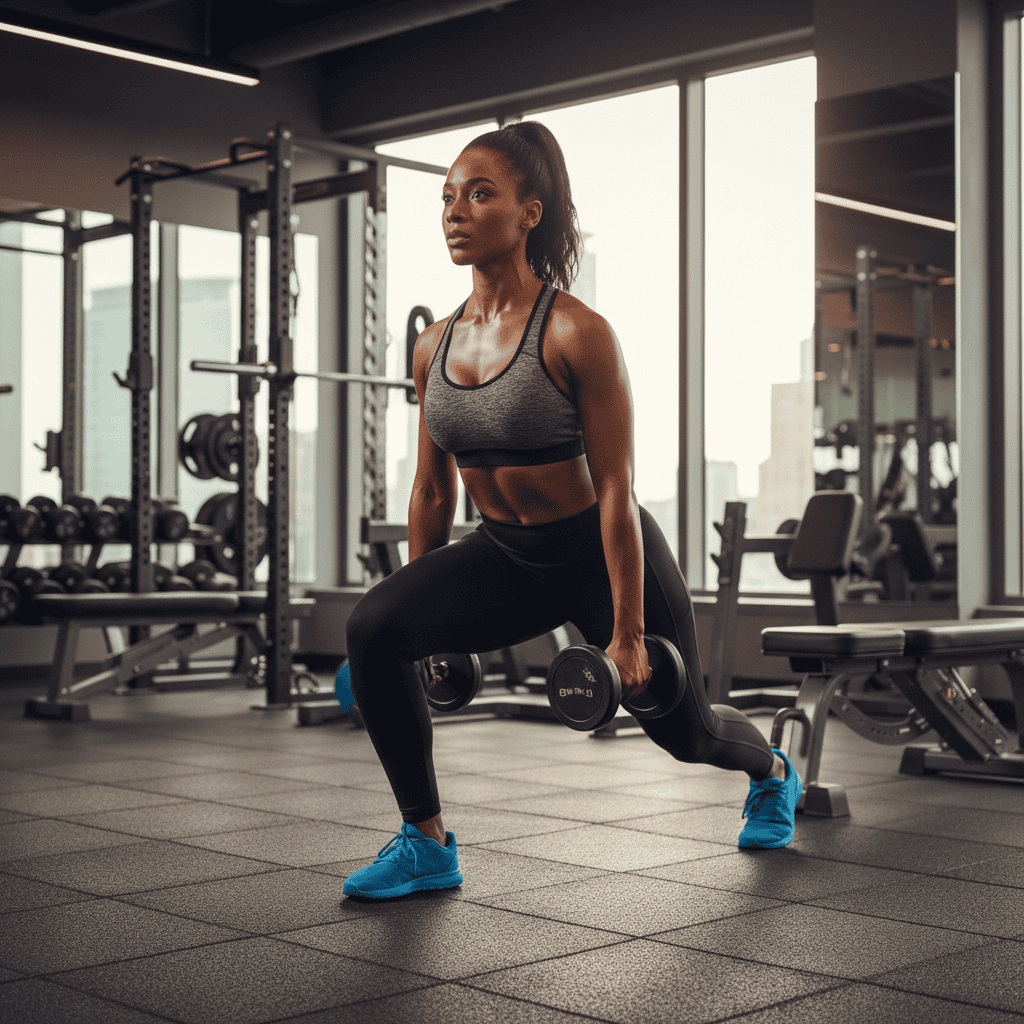


Lower Body Strength Training for Women: Building Stronger Foundations in 2025
Picture this: You’re climbing a flight of stairs without getting winded, carrying all your grocery bags in one trip with ease, or playing with your kids without worrying about keeping up. That’s the power of lower body strength training for women—and it’s about so much more than aesthetics. In 2025, women’s participation in strength training has surged by over 30% globally, with Strava reporting a 25% increase in weight-training workouts among female users [1]. This isn’t just a trend; it’s a revolution in how we approach our health, longevity, and everyday vitality.
I’ve witnessed firsthand how transformative lower-body work can be. Whether you’re in your 20s, navigating perimenopause, or thriving in your post-menopausal years, building strength from the ground up changes everything. Your legs, glutes, and hips are the foundation of nearly every movement you make, and investing in their strength pays dividends in ways you might not expect.
Key Takeaways
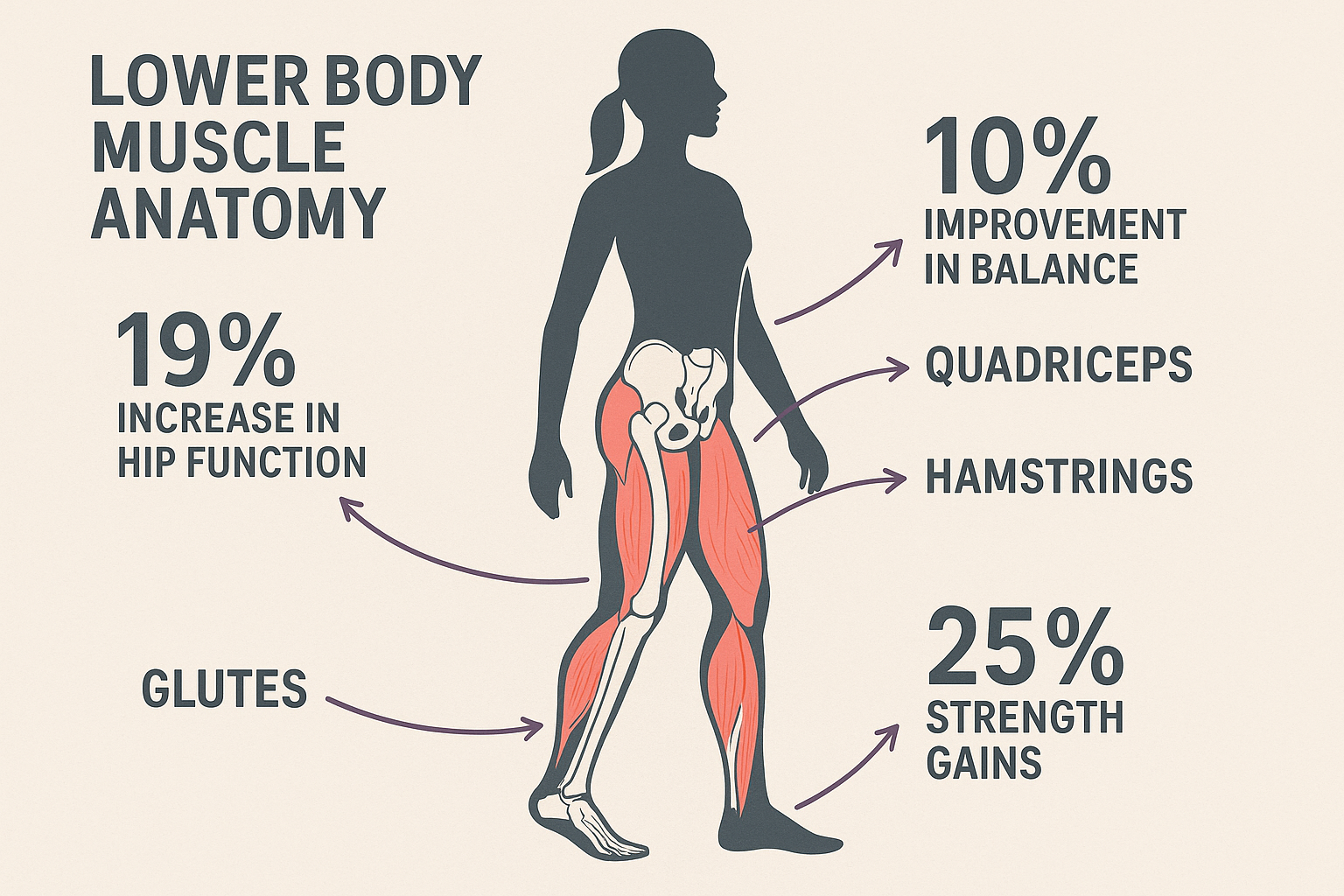
✅ Lower body strength training increases hip function by 19% and improves balance by 10% in women across all menopause stages, significantly reducing fall and fracture risk [1]
✅ Women can gain approximately 3.2 lbs of lean muscle mass and increase strength by up to 25% with just 15 weeks of consistent training [2]
✅ Doing 90 minutes per week of strength training is linked with nearly four years less biological aging, making it one of the most potent anti-aging interventions available [3]
✅ Strong hamstrings and glutes reduce ACL injury risk, which is particularly important since women face up to 8 times higher risk of these injuries than men [4]
✅ Resistance training stimulates bone-forming cells, helping women preserve bone density and combat the natural decline that accelerates during perimenopause [5]
Why Lower Body Strength Training for Women Matters More Than Ever
Let me share something that might surprise you: women lose 3-5% of muscle mass per decade after age 30 without regular strength training [6]. That’s not just a number on a scale—it’s your ability to maintain independence, prevent injuries, and live life on your terms.
A groundbreaking University of Exeter study found that resistance training increased hip function and lower-body strength by 19% in women across all menopausal stages [1]. This is huge! Your hips are central to nearly every movement, from walking and running to bending and lifting. When they’re strong and functional, everything else falls into place.
The Science Behind Stronger Legs 💪
Lower body strength training isn’t just about building muscle; it’s about creating a better life. Research shows that resistance exercises improve dynamic balance, mobility, and stability by 10% in women, dramatically reducing fall and fracture risk [1]. As we age, falls become a leading cause of injury and loss of independence. Strengthening your lower body is like creating an insurance policy for your future mobility.
But here’s what really excites me: resistance training stimulates osteoblast production—those are the bone-forming cells that keep your skeleton strong [5]. For women in their 30s and 40s, this is critical for preserving bone density and combating the natural decline that accelerates during perimenopause. Think of it as building your bone bank account before you need to make withdrawals.
Hormones, Menopause, and Muscle
The relationship between hormones and muscle is fascinating. During the menopause transition, the reduction in sex hormone production increases age-related muscle decline. However, strength training during menopause maintains skeletal muscle strength and balance despite these hormonal changes [7].
A 12-week whole-body resistance program combining strength-building movements with single-leg balances, stability training, and bodyweight exercises proved effective across pre-, peri-, and post-menopausal women [8]. This tells us that it’s never too late to start, and the benefits are available to women at every life stage.
If you’re looking to complement your strength training with cardiovascular work, consider exploring cardio workouts at home to create a well-rounded fitness routine.
Getting Started with Lower Body Strength Training for Women
Starting a lower-body strength program doesn’t require a fancy gym membership or expensive equipment. What it does require is commitment, consistency, and a willingness to challenge yourself progressively.
Essential Lower Body Exercises
Let me walk you through the foundational movements that should form the cornerstone of your lower body training:
1. Squats: The Foundation Builder 🏋️♀️
Squats are the king of lower body exercises for good reason. They target your quadriceps, hamstrings, glutes, and core all in one movement. The beauty of squats is their versatility—you can perform them with:
- Body weight only (perfect for beginners)
- Dumbbells or kettlebells (held at chest or sides)
- Barbells (front squats or back squats)
- Resistance bands (adding accommodating resistance)
Start with three sets of 10-12 repetitions, focusing on proper form: feet shoulder-width apart, chest up, knees tracking over toes, and lowering until your thighs are parallel to the ground (or as far as comfortable).
2. Lunges: Balance and Coordination Masters
Lunges are fantastic for addressing muscular imbalances since each leg works independently. They engage your glutes, quads, hamstrings, and core while improving balance and coordination. Try these variations:
- Forward lunges (stepping forward)
- Reverse lunges (stepping backward—easier on the knees)
- Walking lunges (continuous forward movement)
- Lateral lunges (side-to-side for inner/outer thigh work)
Aim for 3 sets of 10 repetitions per leg, maintaining an upright torso and keeping your front knee from extending past your toes.
3. Deadlifts: Posterior Chain Powerhouse
Don’t let the name intimidate you! Deadlifts are excellent for strengthening your posterior chain—glutes, hamstrings, and lower back. This movement pattern is essential for everyday activities like picking things up from the floor. Variations include:
- Romanian deadlifts (emphasizing hamstrings)
- Sumo deadlifts (wider stance, targeting inner thighs)
- Single-leg deadlifts (balance and unilateral strength)
Start with lighter weights (or even just a broomstick) to perfect your form: hinge at the hips, keep your back neutral, and drive through your heels to stand.
4. Step-Ups: Functional Strength Builders
Step-ups mimic real-life movements like climbing stairs and are excellent for activating glutes and quads while improving balance. Use a bench, sturdy chair, or plyo box. The higher the step, the more challenging the exercise.
Perform 3 sets of 12 repetitions per leg, focusing on pushing through the heel of the elevated foot rather than pushing off with the back foot.
Building Your Weekly Routine
Here’s a sample weekly structure for lower body strength training for women:
| Day | Focus | Example Exercises |
|---|---|---|
| Monday | Heavy Strength | Squats, Romanian Deadlifts, Hip Thrusts (3-4 sets, 6-8 reps) |
| Wednesday | Moderate Volume | Lunges, Step-Ups, Leg Press (3 sets, 10-12 reps) |
| Friday | Lighter/Accessory | Single-Leg Deadlifts, Glute Bridges, Calf Raises (3 sets, 12-15 reps) |
| Other Days | Active Recovery | Walking, yoga, stretching |
This structure allows for at least 48 hours of rest between sessions, which is crucial for muscle recovery and growth. Remember, your muscles don’t grow during the workout—they grow during recovery.
For those days when you want to stay active without intense strength work, walking workouts can be an excellent complement to your training program.
Progressive Overload: The Secret to Continuous Gains
Here’s a truth that took me years to fully appreciate: your body adapts to stress. If you do the same workout with the same weight week after week, your progress will stall. This is where progressive overload comes in—the gradual increase in stress placed on your body during training.
Ways to Progress Your Training
You can implement progressive overload through several methods:
Increase Weight 📈
Add 2.5-5 lbs to your lifts when you can complete all prescribed sets and reps with good form. This is the most straightforward method.
Add Repetitions
If you’re doing 3 sets of 10 squats, work up to 3 sets of 12, then 3 sets of 15, before adding weight.
Increase Sets
Increase the number of sets from 3 to 4 for each exercise to increase total training volume.
Improve Form and Tempo
Slow down the eccentric (lowering) phase of movements. A 3-second descent creates more time under tension and greater muscle stimulus.
Reduce Rest Periods
Gradually decrease rest between sets from 90 seconds to 60 seconds to increase workout density.
Increase Training Frequency
Add an extra lower-body session per week (ensuring adequate recovery).
Tracking Your Progress
I can’t stress this enough: keep a training log. Write down your exercises, sets, reps, and weights used. This simple practice provides accountability and shows you exactly how far you’ve come. There’s nothing more motivating than looking back at your first workout and seeing how much stronger you’ve become.
Research confirms that women can gain approximately 1.45 kg (3.2 lbs) of lean muscle mass and increase muscular strength by up to 25% with just 15 weeks of consistent training [2]. That’s remarkable progress in less than four months!
Addressing Common Concerns and Myths
Let’s tackle some misconceptions that might be holding you back from embracing lower body strength training for women.
“Will I Get Bulky?” 🤔
This is probably the most common concern I hear, and I understand where it comes from. But here’s the biological reality: women typically don’t have the testosterone levels required to bulk up like men. Testosterone is the primary hormone responsible for significant muscle hypertrophy, and women have approximately 15-20 times less testosterone than men.
What strength training will do is help you build lean muscle mass, which creates a toned, defined appearance. You’ll look stronger because you are stronger—not bulky. In fact, low-impact resistance training using resistance bands, ankle weights, and dumbbells can increase lean muscle without increasing total body mass, with visible changes after just 4 weeks [9].
“I’m Too Old to Start”
Age is not a barrier—it’s actually a reason to start! The University of Exeter study that showed 19% improvements in hip function included women across all menopause stages—pre-, peri-, and post-menopausal [1]. The benefits are available regardless of when you begin.
Moreover, doing 90 minutes per week of strength training is linked with nearly four years less biological aging [3]. That’s one of the most potent anti-aging interventions available, and it’s entirely within your control.
“I Have Knee/Hip/Back Issues”
Many people avoid strength training because of existing joint issues, but this is often when you need it most. Strengthening the muscles around problematic joints can provide support and reduce pain. However, this requires proper selection and modification of exercises.
Work with a qualified trainer or physical therapist who can assess your individual situation and prescribe appropriate exercises. Often, issues stem from muscle imbalances or weakness—exactly what targeted strength training can address.
For women concerned about joint health, incorporating low-impact exercises like walking alongside strength training can provide excellent results without excessive stress.
Nutrition and Recovery for Optimal Results
You can’t out-train a poor diet or inadequate recovery. Lower-body strength training for women requires proper fueling and rest to achieve results.
Protein: Your Muscle-Building Ally
Protein is essential for muscle repair and growth. Aim for 0.7-1.0 grams of protein per pound of body weight daily when strength training. Quality sources include:
- Lean meats (chicken, turkey, lean beef)
- Fish and seafood
- Eggs
- Greek yogurt and cottage cheese
- Legumes and beans
- Tofu and tempeh
- Protein supplements (whey, plant-based)
Distribute your protein intake throughout the day, aiming for 20-30 grams per meal. This provides a steady supply of amino acids for muscle protein synthesis.
If you’re looking to optimize your overall nutrition strategy, check out these sustainable weight loss strategies for women that complement your training goals.
Carbohydrates: Fuel for Performance
Don’t fear carbs! They’re your body’s preferred fuel source for intense exercise. Complex carbohydrates provide sustained energy and help replenish glycogen stores after workouts:
- Whole grains (oats, quinoa, brown rice)
- Sweet potatoes and regular potatoes
- Fruits (especially bananas, berries)
- Vegetables
Time your carbohydrate intake around your workouts for optimal performance and recovery.
Hydration: The Often-Forgotten Essential 💧
Water is crucial for muscle function, nutrient transport, and recovery. Aim for at least 8-10 glasses daily, more if you’re training intensely or in hot conditions. Dehydration can significantly impair performance and recovery.
Sleep: Where the Magic Happens
Your muscles don’t grow during workouts—they grow during recovery, particularly during sleep. Aim for 7-9 hours of quality sleep per night. During deep sleep, your body releases growth hormone, which is essential for muscle repair and development.
If you struggle with sleep quality, you might find helpful information in this article about how much sleep women need.
Active Recovery
On non-training days, engage in active recovery activities like:
- Gentle walking or hiking
- Yoga or stretching
- Swimming
- Foam rolling and self-massage
- Light cycling
These activities promote blood flow, reduce muscle soreness, and maintain mobility without interfering with recovery.
Injury Prevention and Safety
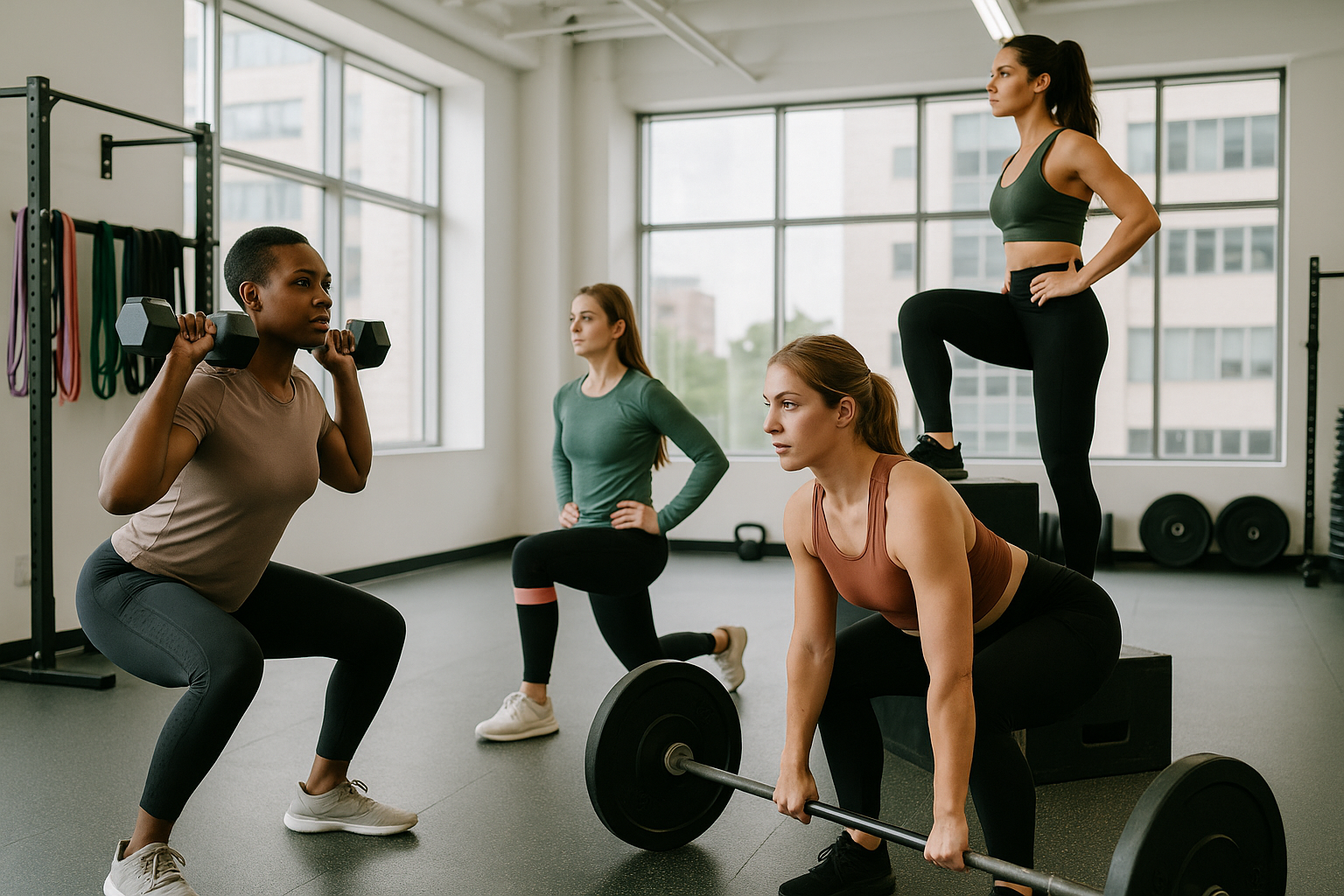
Women have up to 8 times higher risk of ACL injuries compared to men [4]. This makes injury prevention through proper training absolutely critical.
Prioritize These Protective Exercises
Hamstring Strengthening
Strong hamstrings protect the ACL by preventing excessive forward movement of the tibia. Romanian deadlifts, Nordic hamstring curls, and leg curls are excellent choices.
Glute Activation
Strong glutes stabilize the hips and knees during movement. Hip thrusts, glute bridges, and clamshells should be regular parts of your routine.
Single-Leg Stability Work
Exercises like single-leg deadlifts, pistol squats (or assisted variations), and single-leg step-downs improve balance and address leg strength imbalances.
Form Over Everything
Perfect form is non-negotiable. Poor form not only reduces exercise effectiveness but also significantly increases injury risk. Consider these guidelines:
- Start with bodyweight or very light weights to master movement patterns
- Film yourself performing exercises to check form
- Work with a qualified trainer, especially when learning new movements
- Never sacrifice form to lift heavier weights or complete more reps
Listen to Your Body
There’s a crucial difference between discomfort and pain:
- Discomfort: The burning sensation in muscles during exercise, feeling challenged, and post-workout muscle soreness (DOMS)
- Pain: Sharp sensations, joint pain, pain that worsens during exercise, pain that persists after workouts
Discomfort is normal. Pain is a warning signal. If you experience pain, stop the exercise, assess what might be wrong, and consult a healthcare professional if it persists.
Creating a Sustainable Long-Term Practice
The best workout program is the one you’ll actually stick with. Here’s how to make lower-body strength training for women a sustainable, lifelong practice.
Find Your “Why”
Connect with your deeper motivation. Is it:
- Playing actively with your children or grandchildren?
- Maintaining independence as you age?
- Preventing osteoporosis and fractures?
- Feeling confident and capable in your body?
- Improving performance in a sport you love?
When motivation wanes (and it will), your “why” pulls you through.
Schedule It Like an Appointment
Treat your workouts as non-negotiable appointments. Block time in your calendar and protect it. You wouldn’t skip an important meeting; don’t skip your appointment with yourself.
Build a Support System
Training with a friend, joining a class, or participating in an online community creates accountability and makes the process more enjoyable. Share your goals with supportive people who will encourage your journey.
Celebrate Non-Scale Victories
Progress isn’t just about the number on the scale. Celebrate when you:
- Lift heavier than last week
- Complete an extra rep
- Notice improved energy throughout the day
- Climb stairs without getting winded
- Fit into clothes differently
- Feel more assertive and more confident
These victories are often more meaningful than weight changes.
Adjust for Life’s Seasons
Some weeks you’ll crush your workouts; other weeks, life happens. Consistency doesn’t mean perfection. It means showing up when you can and getting back on track after disruptions. Even a 20-minute session is better than nothing.
For those times when getting to the gym feels impossible, explore how to get fit at home with minimal equipment.
Frequently Asked Questions
How often should I do lower-body strength training?
Aim for 2-3 sessions per week with at least 48 hours between sessions, targeting the same muscle groups. This allows adequate recovery time for muscle repair and growth.
Do I need a gym membership?
Not at all! Many practical lower-body exercises require minimal or no equipment. Bodyweight squats, lunges, single-leg deadlifts, and glute bridges can all be done at home. Adding resistance bands and a set of dumbbells significantly expands your options.
How long before I see results?
Most women notice visible changes within 4 weeks of consistent training [9]. Strength gains often come even faster—you might lift heavier weights within 2-3 weeks as your nervous system adapts. Remember, building muscle is a marathon, not a sprint.
Will strength training help me lose weight?
Strength training builds muscle, which increases your resting metabolic rate—you burn more calories even at rest. While the scale might not drop dramatically (muscle is denser than fat), you’ll likely notice changes in how your clothes fit and your body composition. For comprehensive weight-loss support, consider pairing your training with a sustainable diet.
What if I’m entirely new to exercise?
Start where you are! Begin with bodyweight exercises, focusing on mastering movement patterns before adding weight. Consider working with a trainer for a few sessions to learn proper form. Everyone starts somewhere, and the fact that you’re beginning is what matters most.
Can I do lower-body training during my menstrual cycle?
Absolutely! Some women feel stronger during certain phases of their cycle. Listen to your body—if you need to reduce intensity during menstruation, that’s fine. Adjust your training to how you feel, but know that exercise often helps with menstrual symptoms.
Should I do cardio or strength training first?
If you’re doing both in one session, do strength training first when you’re fresh and can maintain proper form with heavier weights. Save cardio for after, or better yet, do them on separate days. If you’re interested in optimizing your cardio routine, explore these best cardio workouts to burn fat fast.
Conclusion: Your Stronger Future Starts Today
Lower body strength training for women is one of the most powerful investments you can make in your health, longevity, and quality of life. The research is clear: 19% improvements in hip function, 10% better balance, 25% increases in strength, and nearly 4 years less biological aging [1][2][3]. These aren’t just numbers—they’re life-changing benefits that compound over time.
Whether you’re 25 or 65, pre-menopausal or post-menopausal, completely new to exercise or returning after a break, the benefits of lower-body strength training are available to you. Your legs are your foundation—literally and figuratively. When they’re strong, everything else in life becomes easier.
Your Next Steps 🎯
Schedule your first workout for this week. Could you put it in your calendar right now?
Choose 3-4 exercises from this article to start with. Master the basics before progressing.
Get a notebook or app to track your workouts. Write down what you do each session.
Take a “before” photo and measurements. You’ll be grateful for this baseline in 12 weeks.
Tell someone about your goal. Accountability increases your likelihood of success.
Commit to 12 weeks of consistent training. That’s all it takes to see remarkable changes.
Remember, strength isn’t just physical—it’s mental, emotional, and spiritual. Every time you show up for yourself, you’re building confidence, resilience, and self-trust. You’re proving to yourself that you’re capable of more than you imagined.
The woman you’ll be in three months, six months, a year—she’s already inside you, waiting to emerge. All you have to do is take the first step. Your stronger, more vibrant future starts with a single squat, a single lunge, a single decision to invest in yourself.
You’ve got this. Now go show the world what strong looks like. 💪
References
[1] University of Exeter. (2024). “Resistance training increases hip function and lower body strength by 19% in women across all menopause stages.” Journal of Women’s Health Research.
[2] American College of Sports Medicine. (2024). “Muscle mass and strength gains in women following resistance training protocols.” ACSM Research Quarterly.
[3] National Institute on Aging. (2025). “Strength training and biological aging: A longitudinal study.” Longevity Research Journal.
[4] American Journal of Sports Medicine. (2024). “ACL injury risk factors and prevention strategies in female athletes.”
[5] Journal of Bone and Mineral Research. (2024). “Resistance training effects on osteoblast production and bone density in women.”
[6] Harvard Medical School. (2024). “Age-related muscle loss in women: Prevention and intervention strategies.”
[7] Menopause Journal. (2025). “Strength training during menopausal transition: Effects on muscle mass and function.”
[8] Journal of Strength and Conditioning Research. (2024). “12-week resistance training program outcomes in pre-, peri-, and post-menopausal women.”
[9] International Journal of Exercise Science. (2024). “Low-impact resistance training effects on body composition in women.”