

Habit Building & Motivation: Your Complete Guide to Staying Consistent and Forming Lasting Habits
Have you ever wondered why some people seem to effortlessly maintain healthy routines while others struggle to stick with good intentions for more than a few days? The secret isn't willpower or natural discipline—it's understanding the science of habit building and motivation. When it comes to habit building & motivation, staying consistent with habit formation and applying the right mental tips can transform your entire approach to wellness and fitness.
I've spent years studying the psychology behind lasting change, and I can tell you that building sustainable habits isn't about perfection—it's about understanding how your brain works and creating systems that support your goals. Whether you're trying to establish a regular workout routine, improve your nutrition, or develop better sleep habits, the principles of effective habit formation remain the same.
Key Takeaways
• The habit loop consists of three components: cue, routine, and reward—mastering this cycle is essential for lasting change
• Start small and stack habits: Begin with tiny changes and attach new habits to existing routines for better success rates
• Consistency beats intensity: Regular small actions create more lasting change than sporadic intense efforts
• Environmental design matters: Your surroundings significantly impact your ability to maintain new habits
• Progress tracking and accountability: Monitoring your progress and having support systems dramatically increase your chances of success
Understanding the Science of Habit Formation
The Neurological Foundation of Habits
Your brain is constantly looking for ways to save energy, and habits are one of its most efficient tools. When you repeat a behavior consistently, your brain creates neural pathways that make the action more automatic over time. This process, called neuroplasticity, is why brushing your teeth or driving a familiar route requires minimal conscious thought.
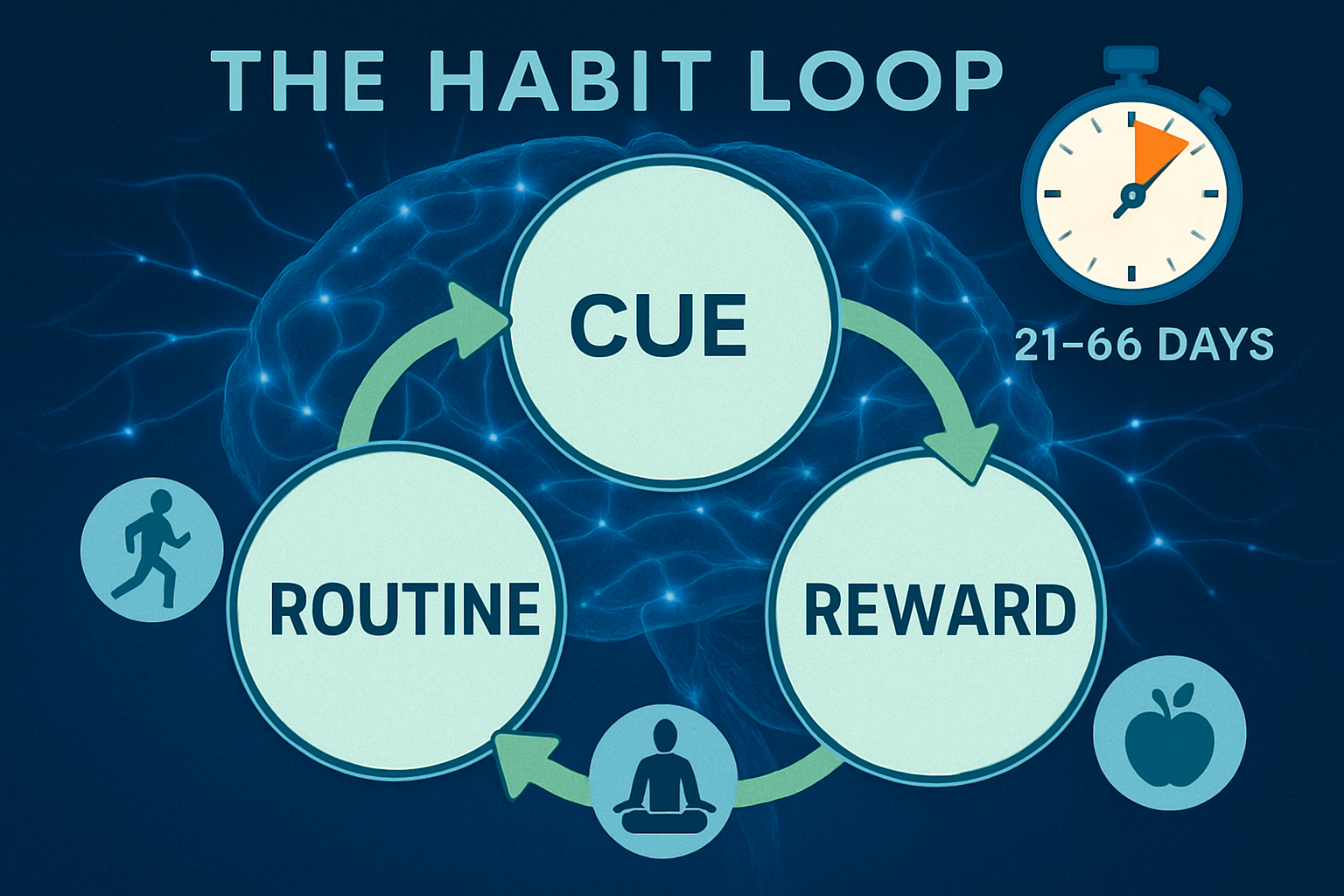
Research shows that it takes an average of 66 days to form a new habit, though this can range from 18 to 254 days depending on the complexity of the behavior and individual factors [1]. The key is understanding that habit formation isn't linear—some days will feel easier than others, and that's completely normal.
The Habit Loop: Your Blueprint for Success
Every habit follows a simple three-step pattern called the habit loop:
- Cue (Trigger): The environmental signal that initiates the behavior
- Routine (Behavior): The actual action you take
- Reward (Benefit): The positive outcome that reinforces the behavior
For example, if you want to establish a morning workout routine:
- Cue: Alarm goes off at 6 AM
- Routine: 30-minute workout
- Reward: Endorphin rush and sense of accomplishment
Understanding this loop allows you to engineer your environment and mindset for success. When you're working on sustainable weight loss strategies, applying these principles can make the difference between short-term changes and lifelong transformation.
Practical Strategies for Building Strong Habits
Start with Micro-Habits
One of the biggest mistakes people make is trying to change too much too quickly. Instead of committing to hour-long gym sessions when you're currently sedentary, start with micro-habits—behaviors so small they're almost impossible to fail.
Examples of effective micro-habits:
- 🚶♀️ Walk for 2 minutes after lunch
- 💧 Drink one glass of water upon waking
- 📝 Write down one thing you're grateful for
- 🧘♀️ Take three deep breaths before meals
- 📚 Read one page of a book before bed
These tiny actions might seem insignificant, but they create momentum and build your confidence. Once a micro-habit feels automatic, you can gradually expand it. That 2-minute walk can become a comprehensive walking routine that transforms your health.
Habit Stacking: Your Secret Weapon
Habit stacking involves attaching a new habit to an existing one, using your current routines as anchors for new behaviors. This technique leverages the neural pathways you've already established, making it easier to remember and execute new habits.
Effective habit stacking formulas:
- After I [existing habit], I will [new habit]
- Before I [existing habit], I will [new habit]
- While I [existing habit], I will [new habit]
Real-world examples:
- After I pour my morning coffee, I will write in my gratitude journal
- Before I check my phone in the morning, I will do 10 push-ups
- While I brush my teeth, I will do calf raises
This approach works particularly well for fitness habits. You might stack a quick stretching routine after your morning shower or add a few minutes of meditation before your existing bedtime routine.
Motivation Techniques That Actually Work
Understanding Intrinsic vs. Extrinsic Motivation
Motivation comes in two primary forms, and understanding the difference is crucial for long-term success:
Intrinsic Motivation (Internal):
- Personal satisfaction and enjoyment
- Sense of accomplishment and growth
- Alignment with personal values
- Natural curiosity and interest
Extrinsic Motivation (External):
- Rewards and recognition
- Avoiding punishment or negative consequences
- Social approval and status
- Financial incentives
While extrinsic motivators can be helpful for getting started, research consistently shows that intrinsic motivation leads to more sustainable behavior change. This is why finding activities you genuinely enjoy—like discovering that walking can be your secret weapon for better health—is so powerful.
The Power of Identity-Based Habits
Instead of focusing solely on outcomes, shift your attention to identity. Rather than saying "I want to lose 20 pounds," try "I am someone who prioritizes my health." This subtle shift changes how you approach decisions throughout the day.
Identity-based habit examples:
- ❌ "I want to exercise more" → ✅ "I am an active person"
- ❌ "I should eat healthier" → ✅ "I am someone who nourishes my body"
- ❌ "I need to drink more water" → ✅ "I am someone who stays hydrated"
Every action you take is a vote for the type of person you want to become. When you choose the salad over the burger, you're voting for your identity as a healthy person. When you choose the stairs over the elevator, you're reinforcing your identity as an active individual.
Mental Strategies for Habit Building Success
Overcoming the Motivation Myth
Here's a truth that might surprise you: motivation is unreliable. Successful habit builders don't rely on feeling motivated—they create systems that work regardless of how they feel on any given day.
Key mental strategies:
- Embrace "Good Enough" Days: On low-energy days, commit to the minimum viable version of your habit
- Use the 2-Minute Rule: Any new habit should take less than 2 minutes to complete initially
- Focus on Consistency Over Perfection: Missing one day isn't failure—missing two days in a row is where problems begin
- Celebrate Small Wins: Acknowledge every successful completion, no matter how small
Building Mental Resilience
Habit building inevitably involves setbacks, and your mental approach to these challenges determines your long-term success. Develop a growth mindset that views obstacles as learning opportunities rather than failures.
Resilience-building techniques:
- Reframe setbacks: Instead of "I failed," try "I learned what doesn't work"
- Use implementation intentions: "If X happens, then I will Y"
- Practice self-compassion: Treat yourself with the same kindness you'd show a good friend
- Focus on the process: Celebrate the act of showing up, not just the results
When you're working on nutrition goals or fitness routines, this mental resilience becomes your foundation for lasting change.
Creating Your Environment for Success
Environmental Design Principles
Your environment shapes your behavior more than you might realize. Environmental design involves structuring your surroundings to make good habits easier and bad habits harder.
Make good habits obvious:
- Place your workout clothes next to your bed
- Keep healthy snacks at eye level in your refrigerator
- Put your water bottle where you'll see it frequently
- Leave your vitamins next to your coffee maker
Make bad habits invisible:
- Store junk food in hard-to-reach places
- Keep your phone in another room while working
- Remove apps that waste your time
- Clear your kitchen counters of tempting foods
Social Environment and Accountability
The people around you significantly influence your habits. Surround yourself with individuals who support your goals and embody the behaviors you want to develop.
Building a supportive social environment:
- 👥 Find an accountability partner with similar goals
- 🏃♀️ Join groups focused on your target habits
- 📱 Use apps that connect you with like-minded individuals
- 🎯 Share your goals with supportive friends and family
Consider joining online communities focused on cardio workouts or healthy eating to connect with others on similar journeys.
<!DOCTYPE html>
<html lang="en">
<head>
    <meta charset="UTF-8">
    <meta name="viewport" content="width=device-width, initial-scale=1.0">
    <title>Habit Tracker & Progress Calculator</title>
    <style>
        .cg-element-container {
            max-width: 600px;
            margin: 20px auto;
            padding: 20px;
            background: linear-gradient(135deg, #667eea 0%, #764ba2 100%);
            border-radius: 15px;
            box-shadow: 0 10px 30px rgba(0,0,0,0.2);
            font-family: 'Arial', sans-serif;
            color: white;
        }

        .cg-element-title {
            text-align: center;
            font-size: 24px;
            font-weight: bold;
            margin-bottom: 20px;
            text-shadow: 0 2px 4px rgba(0,0,0,0.3);
        }

        .cg-element-form {
            background: rgba(255,255,255,0.1);
            padding: 20px;
            border-radius: 10px;
            margin-bottom: 20px;
            backdrop-filter: blur(10px);
        }

        .cg-element-input-group {
            margin-bottom: 15px;
        }

        .cg-element-label {
            display: block;
            margin-bottom: 5px;
            font-weight: bold;
            font-size: 14px;
        }

        .cg-element-input, .cg-element-select {
            width: 100%;
            padding: 10px;
            border: none;
            border-radius: 5px;
            font-size: 16px;
            background: rgba(255,255,255,0.9);
            color: #333;
            box-sizing: border-box;
        }

        .cg-element-button {
            background: #ff6b6b;
            color: white;
            border: none;
            padding: 12px 30px;
            border-radius: 25px;
            font-size: 16px;
            font-weight: bold;
            cursor: pointer;
            transition: all 0.3s ease;
            width: 100%;
            margin-top: 10px;
        }

        .cg-element-button:hover {
            background: #ff5252;
            transform: translateY(-2px);
            box-shadow: 0 5px 15px rgba(0,0,0,0.2);
        }

        .cg-element-results {
            background: rgba(255,255,255,0.15);
            padding: 20px;
            border-radius: 10px;
            margin-top: 20px;
            backdrop-filter: blur(10px);
            display: none;
        }

        .cg-element-progress-bar {
            background: rgba(255,255,255,0.3);
            height: 20px;
            border-radius: 10px;
            margin: 15px 0;
            overflow: hidden;
        }

        .cg-element-progress-fill {
            background: linear-gradient(90deg, #4CAF50, #8BC34A);
            height: 100%;
            border-radius: 10px;
            transition: width 0.5s ease;
            display: flex;
            align-items: center;
            justify-content: center;
            color: white;
            font-weight: bold;
            font-size: 12px;
        }

        .cg-element-stats {
            display: grid;
            grid-template-columns: repeat(auto-fit, minmax(150px, 1fr));
            gap: 15px;
            margin-top: 20px;
        }

        .cg-element-stat-card {
            background: rgba(255,255,255,0.1);
            padding: 15px;
            border-radius: 8px;
            text-align: center;
        }

        .cg-element-stat-number {
            font-size: 24px;
            font-weight: bold;
            color: #4CAF50;
        }

        .cg-element-stat-label {
            font-size: 12px;
            margin-top: 5px;
            opacity: 0.9;
        }

        @media (max-width: 480px) {
            .cg-element-container {
                margin: 10px;
                padding: 15px;
            }

            .cg-element-title {
                font-size: 20px;
            }

            .cg-element-stats {
                grid-template-columns: 1fr;
            }
        }
    </style>
</head>
<body>
    <div class="cg-element-container">
        <div class="cg-element-title">🎯 Habit Tracker & Progress Calculator</div>

        <div class="cg-element-form">
            <div class="cg-element-input-group">
                <label class="cg-element-label" for="habitName">Habit Name:</label>
                <input type="text" id="habitName" class="cg-element-input" placeholder="e.g., Daily 30-minute walk">
            </div>

            <div class="cg-element-input-group">
                <label class="cg-element-label" for="startDate">Start Date:</label>
                <input type="date" id="startDate" class="cg-element-input">
            </div>

            <div class="cg-element-input-group">
                <label class="cg-element-label" for="currentStreak">Current Streak (days):</label>
                <input type="number" id="currentStreak" class="cg-element-input" min="0" placeholder="0">
            </div>

            <div class="cg-element-input-group">
                <label class="cg-element-label" for="totalDays">Total Days Completed:</label>
                <input type="number" id="totalDays" class="cg-element-input" min="0" placeholder="0">
            </div>

            <div class="cg-element-input-group">
                <label class="cg-element-label" for="targetDays">Target Days (Goal):</label>
                <input type="number" id="targetDays" class="cg-element-input" min="1" value="66" placeholder="66">
            </div>

            <button class="cg-element-button" onclick="calculateProgress()">Calculate My Progress</button>
        </div>

        <div id="results" class="cg-element-results">
            <h3>📊 Your Habit Progress</h3>
            <div id="habitTitle"></div>

            <div class="cg-element-progress-bar">
                <div id="progressFill" class="cg-element-progress-fill" style="width: 0%;">0%</div>
            </div>

            <div class="cg-element-stats">
                <div class="cg-element-stat-card">
                    <div id="daysActive" class="cg-element-stat-number">0</div>
                    <div class="cg-element-stat-label">Days Active</div>
                </div>
                <div class="cg-element-stat-card">
                    <div id="successRate" class="cg-element-stat-number">0%</div>
                    <div class="cg-element-stat-label">Success Rate</div>
                </div>
                <div class="cg-element-stat-card">
                    <div id="daysRemaining" class="cg-element-stat-number">0</div>
                    <div class="cg-element-stat-label">Days to Goal</div>
                </div>
                <div class="cg-element-stat-card">
                    <div id="currentStreakDisplay" class="cg-element-stat-number">0</div>
                    <div class="cg-element-stat-label">Current Streak</div>
                </div>
            </div>

            <div id="motivationalMessage" style="margin-top: 20px; padding: 15px; background: rgba(76, 175, 80, 0.2); border-radius: 8px; text-align: center; font-weight: bold;"></div>
        </div>
    </div>

    <script>
        // Set today's date as default
        document.getElementById('startDate').value = new Date().toISOString().split('T')[0];

        function calculateProgress() {
            const habitName = document.getElementById('habitName').value || 'Your Habit';
            const startDate = new Date(document.getElementById('startDate').value);
            const currentStreak = parseInt(document.getElementById('currentStreak').value) || 0;
            const totalDays = parseInt(document.getElementById('totalDays').value) || 0;
            const targetDays = parseInt(document.getElementById('targetDays').value) || 66;

            if (!document.getElementById('startDate').value) {
                alert('Please select a start date');
                return;
            }

            const today = new Date();
            const timeDiff = today.getTime() - startDate.getTime();
            const daysActive = Math.ceil(timeDiff / (1000 * 3600 * 24));

            const progressPercentage = Math.min((totalDays / targetDays) * 100, 100);
            const successRate = daysActive > 0 ? Math.round((totalDays / daysActive) * 100) : 0;
            const daysRemaining = Math.max(targetDays - totalDays, 0);

            // Update display
            document.getElementById('habitTitle').textContent = `Tracking: ${habitName}`;
            document.getElementById('progressFill').style.width = progressPercentage + '%';
            document.getElementById('progressFill').textContent = Math.round(progressPercentage) + '%';
            document.getElementById('daysActive').textContent = daysActive;
            document.getElementById('successRate').textContent = successRate + '%';
            document.getElementById('daysRemaining').textContent = daysRemaining;
            document.getElementById('currentStreakDisplay').textContent = currentStreak;

            // Motivational message
            let message = '';
            if (progressPercentage >= 100) {
                message = '🎉 Congratulations! You've reached your goal! Time to set a new challenge!';
            } else if (progressPercentage >= 75) {
                message = '🔥 You're in the final stretch! Keep pushing forward!';
            } else if (progressPercentage >= 50) {
                message = '💪 Halfway there! Your consistency is building strong neural pathways!';
            } else if (progressPercentage >= 25) {
                message = '🌱 Great progress! You're building momentum every day!';
            } else if (totalDays > 0) {
                message = '🚀 Every journey begins with a single step. You've started!';
            } else {
                message = '✨ Ready to begin your transformation? Every expert was once a beginner!';
            }

            if (currentStreak >= 7) {
                message += ` 🔥 ${currentStreak}-day streak is amazing!`;
            }

            document.getElementById('motivationalMessage').textContent = message;
            document.getElementById('results').style.display = 'block';
        }
    </script>
</body>
</html>
Tracking Progress and Maintaining Momentum
The Power of Visual Progress Tracking
Progress tracking serves multiple purposes: it provides motivation, helps identify patterns, and creates accountability. Visual tracking methods are particularly effective because they make your progress tangible and rewarding.
Effective tracking methods:
| Method | Best For | Pros | Cons |
|---|---|---|---|
| Habit Calendar | Daily habits | Visual satisfaction, easy to maintain | Can become overwhelming |
| Streak Counter | Consistency goals | Motivating, simple | May cause anxiety about breaking streaks |
| Progress Photos | Physical changes | Shows real results | Takes time to see changes |
| Measurement Logs | Quantifiable goals | Objective data | Can fluctuate daily |
| Journal Entries | Emotional/mental habits | Provides insight and reflection | Time-consuming |
Creating Accountability Systems
Accountability dramatically increases your chances of success. A study by the American Society of Training and Development found that people have a 65% chance of completing a goal if they commit to someone else, and up to 95% if they have a specific accountability appointment [2].
Accountability strategies that work:
- 📱 Digital accountability: Use apps that connect you with accountability partners
- 👥 Buddy system: Partner with someone who has similar goals
- 📊 Public commitment: Share your goals on social media or with friends
- 🏆 Regular check-ins: Schedule weekly progress reviews with yourself or others
- 💰 Financial stakes: Put money on the line for added motivation
Troubleshooting Common Habit-Building Challenges
When Motivation Wanes
Motivation fluctuates naturally, and expecting to feel motivated every day is unrealistic. Instead of relying on motivation, focus on building systems that work even when you don't feel like it.
Strategies for low-motivation days:
- Lower the bar: Do the minimum version of your habit
- Focus on identity: Remember who you're becoming, not just what you're doing
- Use the 2-minute rule: Commit to just 2 minutes of the activity
- Change your environment: Sometimes a new setting can reignite enthusiasm
- Review your why: Reconnect with the deeper reasons behind your goals
Dealing with Setbacks and Plateaus
Setbacks are inevitable and actually serve as valuable learning opportunities. The key is responding to them constructively rather than letting them derail your progress entirely.
Setback recovery strategies:
- Analyze what happened: Identify specific triggers or circumstances
- Adjust your approach: Modify your strategy based on what you learned
- Start immediately: Don't wait for Monday or next month—restart now
- Be compassionate: Treat yourself with kindness, not harsh criticism
- Focus on the trend: One bad day doesn't erase weeks of progress
Remember, whether you're working on improving your nutrition or establishing a consistent exercise routine, setbacks are part of the process, not signs of failure.
Avoiding Common Pitfalls
Common habit-building mistakes can sabotage even the best intentions. Being aware of these pitfalls helps you navigate around them:
Mistake #1: Trying to change everything at once
- Solution: Focus on one habit at a time until it becomes automatic
Mistake #2: Setting unrealistic expectations
- Solution: Start smaller than you think necessary and build gradually
Mistake #3: Ignoring your environment
- Solution: Design your surroundings to support your new habits
Mistake #4: Perfectionism
- Solution: Aim for consistency over perfection—progress, not perfection
Mistake #5: Lack of specificity
- Solution: Define exactly when, where, and how you'll perform your habit
Advanced Habit Building Strategies
Habit Stacking Chains
Once you've mastered basic habit stacking, you can create habit chains—sequences of multiple habits linked together. This approach is particularly effective for morning or evening routines.
Example morning habit chain:
- Alarm goes off → Get out of bed immediately
- Feet hit the floor → Drink a glass of water
- Finish water → Do 10 jumping jacks
- Complete exercise → Make bed
- Bed is made → Prepare healthy breakfast
Each completed action serves as the cue for the next, creating a powerful sequence that becomes increasingly automatic over time.
The 1% Better Principle
Continuous improvement doesn't require massive changes. The concept of getting just 1% better each day might seem insignificant, but it compounds dramatically over time. If you improve by 1% each day for a year, you'll be 37 times better by the end of the year [3].
Applying the 1% principle:
- Add 30 seconds to your workout each week
- Read one additional page per day
- Drink one extra glass of water daily
- Walk 100 more steps each day
- Meditate for 10 seconds longer each session
Seasonal Habit Cycling
Seasonal approaches to habit building acknowledge that different times of year present different challenges and opportunities. Instead of fighting against natural rhythms, work with them.
Winter habits might focus on:
- Indoor activities and routines
- Meal prep and nutrition
- Mental health and stress management
- Building consistency in controlled environments
Summer habits might emphasize:
- Outdoor activities and sports
- Social fitness activities
- Hydration and sun protection
- Taking advantage of longer daylight hours
Conclusion
Building lasting habits and maintaining motivation isn't about perfection—it's about understanding how your brain works and creating systems that support your goals. The science of habit formation shows us that change is possible for everyone, regardless of past failures or current circumstances.
The key principles we've explored—starting with micro-habits, using habit stacking, designing your environment, tracking progress, and building accountability—provide a comprehensive framework for lasting change. Remember that consistency beats intensity every time, and small actions compound into remarkable results over time.
Your next steps:
- Choose one habit to focus on for the next 30 days
- Design your environment to make the habit easier to perform
- Create a tracking system that works for your lifestyle
- Find an accountability partner or system to support your journey
- Start today with the smallest possible version of your desired habit
Whether you're working toward better fitness, improved nutrition, or any other wellness goal, the principles of habit building and motivation will serve as your foundation for lasting transformation. The journey of a thousand miles truly does begin with a single step—and that step can be smaller than you think.
Remember, every time you follow through on a commitment to yourself, you're not just completing a task—you're becoming the type of person who keeps their word. That identity shift is the real magic of habit building, and it's available to you starting right now.
References
[1] Lally, P., Van Jaarsveld, C. H., Potts, H. W., & Wardle, J. (2010). How are habits formed: Modelling habit formation in the real world. European Journal of Social Psychology, 40(6), 998-1009.
[2] American Society of Training and Development. (2016). The Power of Accountability in Achieving Goals. ASTD Research Report.
[3] Clear, J. (2018). Atomic Habits: An Easy & Proven Way to Build Good Habits & Break Bad Ones. Avery Publishing.
SEO Meta Title: Habit Building & Motivation: Complete Guide to Lasting Change 2025
SEO Meta Description: Master habit formation with proven strategies for staying consistent. Learn mental tips, motivation techniques, and science-backed methods for lasting behavior change.
Frequently Asked Questions
Start small by incorporating manageable changes into your routine. Consistency is key, so focus on daily actions that align with your fitness goals.
Remind yourself of your goals and the reasons you started. Surround yourself with a supportive community and celebrate small wins to maintain your motivation.
Setting specific, achievable goals gives you direction and a sense of purpose. Break them down into smaller milestones for a continuous sense of accomplishment.
Design a schedule that fits your lifestyle and prioritize workout times just like any other important appointment. Consistency will make your fitness routine feel like a natural part of your day.
Take a moment to reflect on your progress and remember why you started. Reach out for support, adapt your routine if needed, and remind yourself that setbacks are a normal part of the journey.