

Beginner Strength Training Plan: Your Complete Guide to Getting Started in 2025
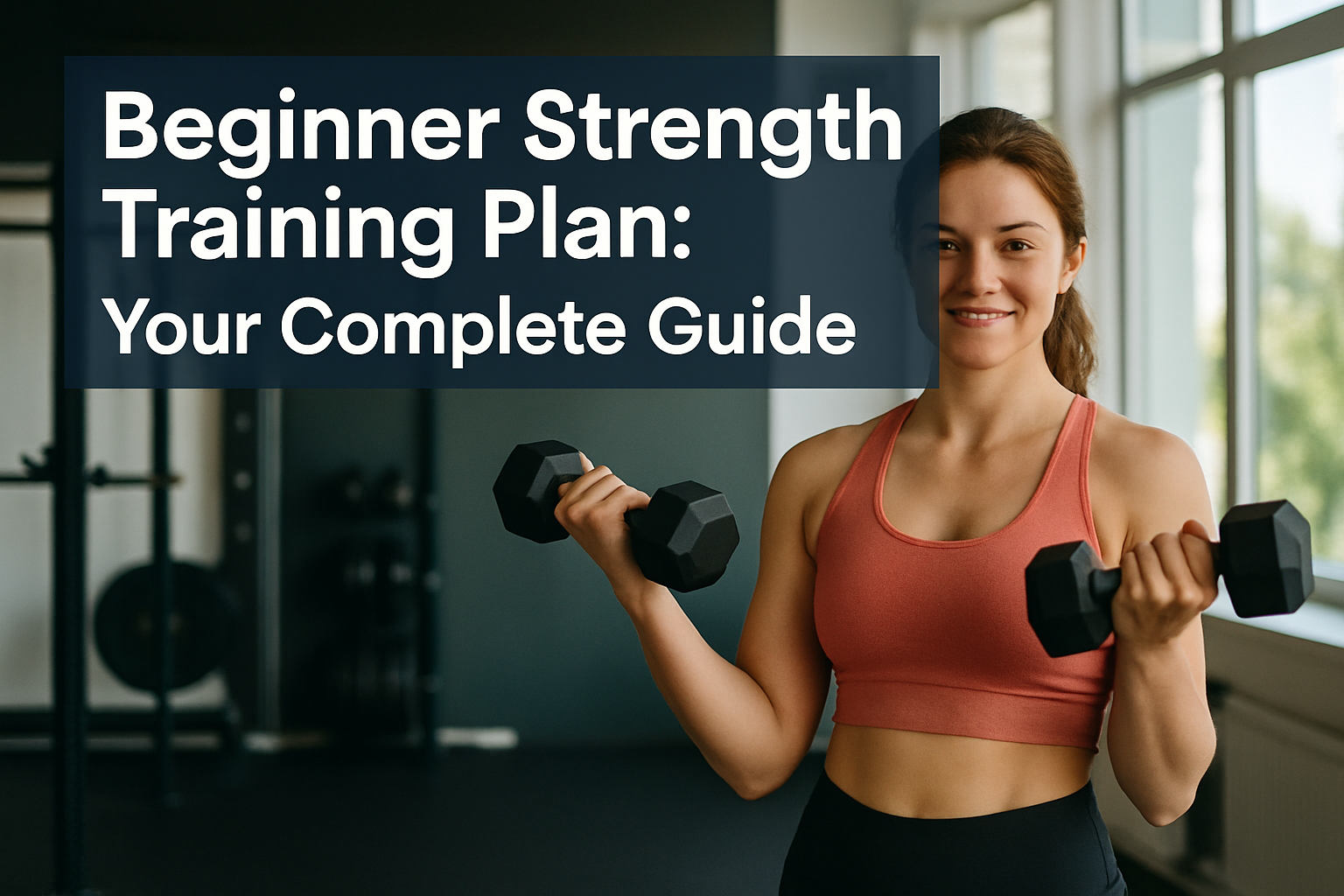
Picture this: you’re standing at the entrance of the gym, heart racing, palms sweaty, completely overwhelmed by the sea of equipment and confident gym-goers around you. Or maybe you’re at home, staring at a set of dumbbells, wondering if you’re about to make a fool of yourself. I’ve been there, and I know exactly how intimidating it can feel to start your fitness journey. But here’s the truth: every strong woman you admire started exactly where you are right now. Today, I’m going to walk you through creating a beginner strength training plan that will transform your uncertainty into confidence, one rep at a time. 💪
Whether you want to feel stronger carrying groceries, keep up with your kids, or simply reclaim your physical power, this guide will give you everything you need to succeed.
Key Takeaways
- Start with 3-4 strength training sessions per week to build consistency without burnout, focusing on full-body workouts that target all major muscle groups
- Master the 8-12 rep range with 2-3 sets per exercise to build both muscle strength and endurance while perfecting your form
- Progressive overload is essential: gradually increase weight, reps, or intensity every 3 sessions to continue seeing results
- Prioritize proper form over heavy weights to prevent injury and build a solid foundation for long-term strength gains
- Expect visible results within 4 weeks when following a structured program consistently, with significant strength improvements continuing over time
Why Strength Training Is a Game-Changer for Women
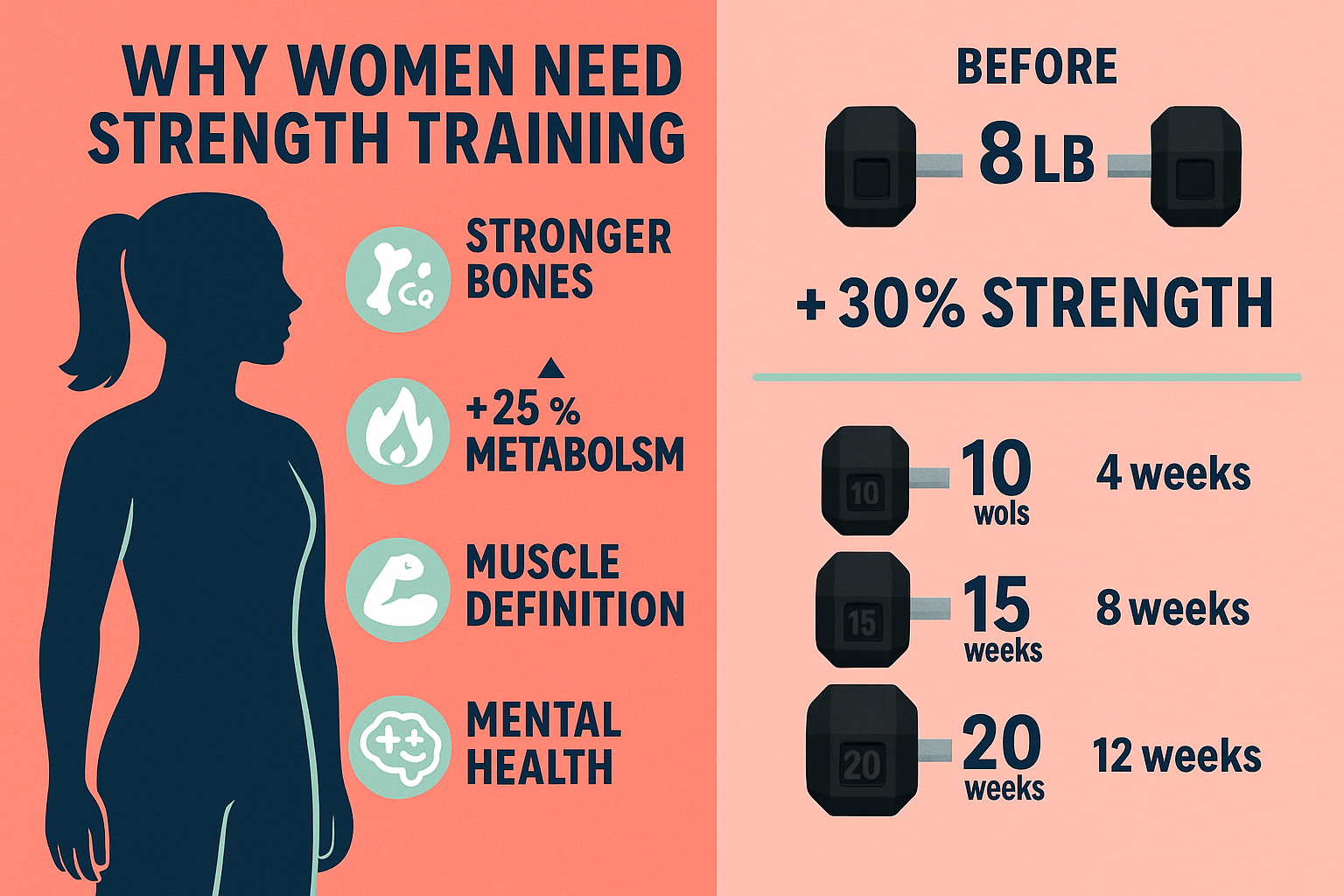
Before we dive into your beginner strength training plan, let’s talk about why this matters so much. I’m not going to sugarcoat it—strength training is one of the most powerful things you can do for your body and mind.
The Physical Benefits 🏋️♀️
Strength training builds muscle, yes, but it does so much more. It boosts your metabolism, meaning you burn more calories even while binge-watching your favorite show. It strengthens your bones, which is crucial for preventing osteoporosis as we age. And contrary to popular myths, it won’t make you “bulky”—it will make you strong, toned, and capable.
Research shows that women who engage in regular strength training experience:
- Increased bone density by up to 15%, reducing fracture risk [1]
- Metabolic rate increases of 7-8%, helping with weight management [2]
- Improved insulin sensitivity and better blood sugar control
- Enhanced cardiovascular health and reduced blood pressure
- Better posture and reduced back pain
The Mental and Emotional Wins 🧠
Here’s what surprised me most when I started: the mental health benefits. Engaging regularly in a strength routine can help alleviate symptoms of anxiety and depression. The endorphins released during workouts improve mood and contribute to a genuine sense of achievement. Plus, there’s something incredibly empowering about watching yourself get stronger week after week.
Furthermore, strength training enhances cognitive function, helping to improve focus and reduce the risk of cognitive decline as you age [3]. When you’re lifting weights, you’re not just building muscle—you’re building mental resilience, discipline, and self-confidence that carries into every area of your life.
If you’re looking to complement your strength training with other wellness approaches, you might find value in exploring how to get fit at home for a comprehensive fitness strategy.
Setting Realistic Goals for Your Beginner Strength Training Plan
Alright, you might be itching to jump right in, but first, let’s set some goals. It’s crucial to know why you’re doing this. Is it to gain muscle, lose weight, or improve your energy levels? Maybe you want to run after your kids without feeling winded, or perhaps you’re tired of asking for help opening jars. Whatever it is, jot it down. Trust me, having a clear goal makes all the difference.
The SMART Goal Framework
Setting SMART goals—Specific, Measurable, Achievable, Relevant, and Time-bound—can be incredibly helpful. For instance, instead of vaguely aiming to “get stronger,” you could set a goal to “perform 10 full push-ups from my toes within 8 weeks” or “increase my squat weight by 20 pounds in three months.”
Here are some examples of great beginner goals:
| Goal Type | Example | Timeline |
|---|---|---|
| Strength | Increase dumbbell shoulder press from 8lbs to 12lbs | 6 weeks |
| Endurance | Complete 3 sets of 12 squats without rest | 4 weeks |
| Consistency | Attend 3 strength sessions per week | Ongoing |
| Form Mastery | Perform 5 perfect push-ups from toes | 8 weeks |
| Overall Fitness | Feel energized throughout the day | 12 weeks |
Remember, goals should be flexible. It’s perfectly okay to adjust them as you progress and learn more about what your body is capable of. The journey isn’t linear, and that’s completely normal.
Crafting Your Beginner Strength Training Plan: The Essentials
Now, onto the fun part—crafting your workout plan. You’re going to want a balanced routine that targets all the major muscle groups: legs, back, chest, shoulders, arms, and core. This full-body approach is ideal for beginners because it allows you to train each muscle group multiple times per week while still getting adequate recovery [4].
The Foundation: Full-Body Training Split
For beginners, full-body training splits work best. This means you’ll train all major body parts in each session, typically 3 times per week. This approach provides:
- Frequent muscle stimulation for faster strength gains
- Better movement pattern learning through repetition
- Flexibility in scheduling (missing one workout isn’t catastrophic)
- Efficiency for busy schedules
Here’s a simple breakdown of what to include:
1. Legs: Your Powerhouse Foundation 🦵
Think squats and lunges. These are your bread and butter. They work the largest muscles in your body and burn a ton of calories. Start with bodyweight exercises before adding weights.
Key exercises:
- Bodyweight squats: 3 sets of 10-12 reps
- Walking lunges: 2 sets of 8-10 reps per leg
- Glute bridges: 3 sets of 12-15 reps
Incorporating variations like split squats or Bulgarian split squats can add diversity and challenge to your routine. As you progress, you might consider incorporating equipment like kettlebells or barbells to further increase resistance and continue building strength.
2. Back: Build Your Posture Power 💪
Rows and pull-ups are fantastic for back strength. If pull-ups sound daunting, don’t fret. Use an assisted machine or resistance bands to build up your strength.
Key exercises:
- Bent-over dumbbell rows: 3 sets of 10-12 reps
- Resistance band rows: 2 sets of 12-15 reps
- Superman holds: 3 sets of 20-30 seconds
Developing back strength is crucial for posture and preventing injuries. Consider including exercises like deadlifts and lat pulldowns in your routine as you advance. These exercises not only engage your back muscles but also activate other muscle groups, giving you a comprehensive workout.
3. Chest: Upper Body Strength ✨
Push-ups and bench presses will be your go-to. Start with push-ups on your knees if needed. It’s all about progression, not perfection.
Key exercises:
- Modified push-ups (knees or incline): 3 sets of 8-10 reps
- Dumbbell chest press: 2 sets of 10-12 reps
- Wall push-ups: 2 sets of 12-15 reps (for absolute beginners)
For an added challenge, try variations like incline or decline push-ups. These work different parts of your chest and keep your routine dynamic.
4. Shoulders: Reach New Heights 🙌
Shoulder presses and lateral raises are key. They’ll help you with everyday tasks like reaching for that top shelf or putting luggage in the overhead compartment.
Key exercises:
- Dumbbell shoulder press: 3 sets of 10-12 reps
- Lateral raises: 2 sets of 12-15 reps
- Front raises: 2 sets of 10-12 reps
Don’t shy away from including exercises like the Arnold press to really target those shoulder muscles. A strong shoulder girdle not only enhances your upper body strength but also aids in maintaining good posture and preventing injuries.
5. Arms: Functional Strength 💪
For those biceps and triceps, curls and dips are fantastic. Don’t worry about bulking up too much—it’s all about getting toned and strong.
Key exercises:
- Dumbbell bicep curls: 2 sets of 10-12 reps
- Tricep dips (on chair or bench): 2 sets of 8-10 reps
- Hammer curls: 2 sets of 10-12 reps
Try incorporating variations like tricep kickbacks to keep your arm workouts engaging. Building arm strength contributes significantly to overall upper body function and aesthetics.
6. Core: Your Stability Center 🎯
Planks and crunches will help stabilize your core. A strong core supports everything else, making these exercises crucial for injury prevention and overall functional fitness.
Key exercises:
- Forearm plank: 3 sets of 20-45 seconds
- Dead bug: 2 sets of 10 reps per side
- Bird dog: 2 sets of 10 reps per side
Consider adding exercises like Russian twists or mountain climbers for a comprehensive core workout. A strong core not only supports your strength training efforts but also enhances your overall balance and stability.
For additional core-focused exercises, check out these women’s abs exercises that complement your strength training routine.
Your Weekly Beginner Strength Training Plan Schedule
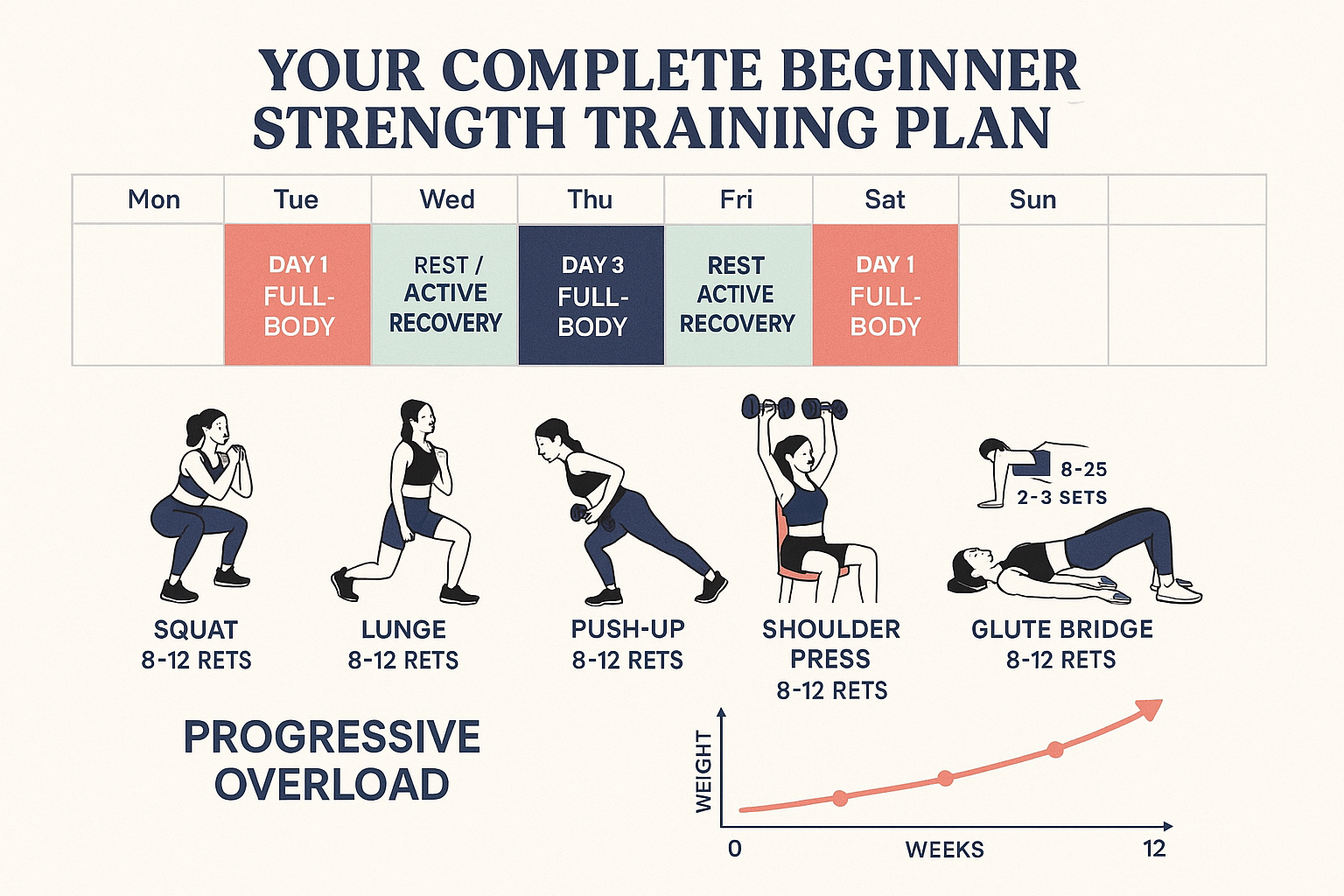
You’re probably wondering, “How often should I do this?” A good starting point is 3-4 times a week. Give yourself a day of rest in between sessions to let those muscles recover and grow. This frequency allows beginners to build strength and consistency without risking burnout [5].
Sample Weekly Schedule
Here’s a practical weekly layout:
Option 1: 3-Day Full-Body Split
- Monday: Full-body strength training
- Tuesday: Rest or light activity (walking workouts)
- Wednesday: Full-body strength training
- Thursday: Rest or yoga for women
- Friday: Full-body strength training
- Saturday: Active recovery (gentle stretching, walking)
- Sunday: Complete rest
Option 2: 4-Day Full-Body Split
- Monday: Full-body strength training
- Tuesday: Active recovery
- Wednesday: Full-body strength training
- Thursday: Rest
- Friday: Full-body strength training
- Saturday: Full-body strength training
- Sunday: Complete rest
As you become more experienced, you might consider splitting your workouts into different muscle groups (upper/lower split or push/pull/legs) or increasing your frequency to 4-5 times a week.
Sets, Reps, and Rest Periods
The ideal rep range for beginner strength training is 8-12 reps per set, which builds both muscle size (hypertrophy) and muscular endurance while helping you master proper form [6].
Here’s your formula:
- Sets: 2-3 sets of each exercise
- Reps: 8-12 repetitions per set
- Rest: 60-90 seconds between sets
- Workout duration: 45-60 minutes total
This structure allows adequate recovery while maintaining training intensity. The last 2-3 reps of each set should feel challenging but still allow you to maintain good form.
The 3-3-3 Rule: Your Secret Weapon
Let me share one of my favorite frameworks for beginners: the 3-3-3 rule. It’s simple, memorable, and incredibly effective:
- Complete 3 workouts per week (consistency is key)
- Maintain each routine for 3 weeks (allow adaptation)
- Progress slightly every 3 sessions through heavier weight or more reps (progressive overload)
This rule provides structure while keeping things simple. It prevents you from changing things too quickly (which hinders progress) or staying stagnant (which leads to plateaus).
Progressive Overload: The Key to Continuous Improvement
Here’s a truth bomb: your body adapts. That means what challenges you today won’t challenge you in a month. This is where progressive overload comes in—gradually increasing weight, reps, or intensity over time to continue building muscle and strength after initial adaptations [7].
How to Implement Progressive Overload
You can progress in several ways:
- Increase weight: Add 2-5 pounds when you can complete all sets with good form
- Add reps: Increase from 8 to 10 to 12 reps before adding weight
- Add sets: Move from 2 to 3 sets of an exercise
- Decrease rest time: Reduce rest periods from 90 to 75 to 60 seconds
- Improve form: Slow down your tempo or increase range of motion
Example progression:
- Week 1-3: Squats with 10lb dumbbells, 3 sets of 8 reps
- Week 4-6: Squats with 10lb dumbbells, 3 sets of 10 reps
- Week 7-9: Squats with 10lb dumbbells, 3 sets of 12 reps
- Week 10-12: Squats with 12lb dumbbells, 3 sets of 8 reps
This gradual approach ensures continuous progress while minimizing injury risk.
Equipment Essentials: What You Actually Need
Good news: you don’t need a fully equipped gym to start your beginner strength training plan. Here’s what I recommend:
Minimal Equipment Setup (Home Gym)
- Dumbbells: 8-20 pounds depending on exercise and fitness level [8]
- Start with 8lb and 12lb pairs
- Add 15lb and 20lb as you progress
- Resistance bands: Set with varying resistance levels
- Yoga mat: For floor exercises and stretching
- Sturdy chair or bench: For support and certain exercises
- Optional: Kettlebell (15-20lbs to start)
Weight Selection Guide
Most beginners require dumbbells ranging from 8-20 pounds depending on the exercise. Here’s a general guideline:
| Exercise | Starting Weight Range |
|---|---|
| Shoulder press | 5-10 lbs |
| Bicep curls | 8-12 lbs |
| Dumbbell rows | 10-15 lbs |
| Goblet squats | 12-20 lbs |
| Chest press | 10-15 lbs |
The golden rule: Weight selection should be based on the last few reps being challenging while maintaining good form. If you can easily complete 12 reps, it’s time to increase the weight.
Warm-Up and Cool-Down: Non-Negotiable Elements
I can’t stress this enough: warming up is essential. Spend 5-10 minutes getting your heart rate up with some light cardio—jogging in place, jumping jacks, or a brisk walk. This prepares your muscles and helps prevent injuries.
Effective Warm-Up Routine (8-10 minutes)
Light cardio (3-5 minutes):
- Brisk walking
- Marching in place
- Light jogging
- Jumping jacks
Dynamic stretches (5 minutes):
- Leg swings (front-to-back and side-to-side)
- Arm circles
- Torso twists
- Hip circles
- Bodyweight squats
- Lunges with rotation
Dynamic stretches that mimic the movements you’ll be performing in your workout help get your muscles ready for action and reduce the risk of strains or sprains.
Cool-Down Routine (5-10 minutes)
After your workout, take time to:
- Walk slowly for 2-3 minutes to bring heart rate down
- Static stretching for all major muscle groups (hold 20-30 seconds each)
- Deep breathing to promote recovery
This cool-down helps reduce muscle soreness and improves flexibility over time.
Form Over Everything: Mastering the Basics
Let me be crystal clear about this: proper form and controlled movement patterns should be prioritized over lifting heavy weight. I’ve seen too many beginners (myself included, back in the day) rush to add weight before mastering the fundamentals.
Why Form Matters
Poor form leads to:
- Injuries (strains, sprains, joint damage)
- Ineffective workouts (wrong muscles doing the work)
- Bad habits that are hard to break later
- Plateaus in strength gains
Form Checkpoints for Key Exercises
Squats:
- Feet shoulder-width apart
- Knees track over toes (don’t cave inward)
- Chest up, core engaged
- Weight in heels
- Depth: thighs parallel to ground or slightly below
Push-ups:
- Hands slightly wider than shoulders
- Body in straight line from head to heels
- Core engaged (no sagging hips)
- Elbows at 45-degree angle
- Full range of motion (chest nearly touches ground)
Dumbbell rows:
- Neutral spine (flat back)
- Pull with elbow, not hand
- Squeeze shoulder blade at top
- Controlled lowering
- No twisting through torso
Consider recording yourself or working with a trainer for your first few sessions to ensure you’re moving correctly. It’s an investment that pays dividends in the long run.
Rest and Recovery: When Not Training Matters Most
Here’s something that might surprise you: rest and recovery days are as important as training days. Your muscles don’t grow during your workout—they grow during recovery. Beginners should include at least 1 dedicated rest day per week and take active recovery days between intense sessions [9].
The Science of Recovery
When you strength train, you create microscopic tears in your muscle fibers. During rest, your body repairs these tears, making the muscles stronger and larger. Without adequate recovery:
- Muscles can’t repair and grow
- Risk of injury increases
- Performance decreases
- Motivation plummets
- Immune system weakens
Active Recovery Ideas
Active recovery means gentle movement that promotes blood flow without taxing your muscles:
- Light walking (walking for fitness is excellent)
- Gentle yoga or stretching
- Swimming or water aerobics
- Cycling at easy pace
- Foam rolling
Pay attention to any signs of overtraining, such as persistent fatigue, decreased performance, or mood changes. Recovery, including adequate sleep (7-9 hours) and proper hydration, is just as important as the workouts themselves.
If you’re experiencing persistent fatigue, you might want to explore what causes fatigue to ensure you’re addressing any underlying issues.
Nutrition: Fueling Your Strength Training Success
Strength training and nutrition go hand in hand. Make sure you’re fueling your body with the right foods. Protein is your friend—chicken, fish, beans, tofu, Greek yogurt, and nuts are great sources. And don’t forget those carbs and healthy fats. They give you the energy to power through your workouts.
Macronutrient Breakdown for Strength Training
Protein (0.7-1g per pound of body weight):
- Builds and repairs muscle tissue
- Sources: lean meats, fish, eggs, dairy, legumes, protein powder
Carbohydrates (45-55% of total calories):
- Provides energy for workouts
- Replenishes glycogen stores
- Sources: whole grains, fruits, vegetables, sweet potatoes
Healthy Fats (20-30% of total calories):
- Supports hormone production
- Aids nutrient absorption
- Sources: avocados, nuts, olive oil, fatty fish
Meal Timing Strategies
Pre-workout (1-2 hours before):
- Combination of carbs and protein
- Example: banana with almond butter, Greek yogurt with berries
Post-workout (within 1-2 hours):
- Protein for muscle repair
- Carbs to replenish energy
- Example: protein shake with fruit, chicken with rice and vegetables
Hydration Is Critical
Water supports every cellular function, including muscle contraction and recovery. Aim for:
- Minimum: Half your body weight in ounces daily
- During workouts: Add 8-16oz
- Signs of adequate hydration: Clear to pale yellow urine
Consider consulting a nutritionist to tailor a diet that complements your training and aligns with your goals. If you’re interested in specific nutrition approaches, you might explore optimal nutrition for women’s health for comprehensive guidance.
For those interested in complementary dietary approaches, the keto diet or smoothie diet might align with your wellness goals.
Tracking Progress: Measure What Matters
Keep a journal or use an app to track your workouts. Note down the exercises, sets, reps, weights used, and how you felt. It’s a fantastic way to see how far you’ve come and keeps you motivated. Plus, who doesn’t love ticking off completed tasks? ✅
What to Track
Workout metrics:
- Exercises performed
- Weight used
- Sets and reps completed
- Rest periods
- Total workout time
Physical measurements:
- Body weight (weekly, same day/time)
- Body measurements (monthly)
- Progress photos (every 4 weeks)
- How clothes fit
Subjective measures:
- Energy levels (1-10 scale)
- Mood and motivation
- Sleep quality
- Muscle soreness
- Overall well-being
Celebrating Milestones
Tracking your progress not only provides motivation but also helps you identify patterns and make informed decisions about your training. Regularly reviewing your progress allows you to set new goals and celebrate milestones, keeping your journey exciting and fulfilling.
Celebrate when you:
- Complete your first full push-up from toes
- Increase weight on any exercise
- Maintain consistency for 4 weeks straight
- Notice improved energy throughout the day
- Receive compliments on your strength or appearance
Timeline: What to Expect and When
Most beginners can expect to see significant physical improvements within 4 weeks when following a structured strength training program with progressive intensity increases [10]. But let’s break down the realistic timeline:
Week 1-2: Neural Adaptation
- What’s happening: Your nervous system is learning movement patterns
- What you’ll notice: Exercises feel easier, better coordination
- Strength gains: Minimal visible muscle growth, but rapid strength improvements
Week 3-4: Initial Changes
- What’s happening: Muscles beginning to adapt and grow
- What you’ll notice: Increased energy, better sleep, clothes fitting differently
- Strength gains: Noticeable improvements in weights lifted
Week 5-8: Visible Progress
- What’s happening: Muscle definition emerging, body composition changing
- What you’ll notice: Visible muscle tone, compliments from others
- Strength gains: Significant increases in all lifts
Week 9-12: Transformation
- What’s happening: Established habits, confident in gym
- What you’ll notice: Completely different relationship with fitness
- Strength gains: May have doubled strength in some exercises
Remember, everyone’s timeline is different. Factors like genetics, nutrition, sleep, stress, and consistency all play a role.
Staying Motivated: The Mental Game
Let’s face it, we all hit slumps. On those days, remember why you started. Maybe it’s to feel healthier, stronger, or more confident. Whatever it is, keep that reason close. Surround yourself with supportive people, and if you can, find a workout buddy. Having someone to cheer you on makes a world of difference.
Motivation Strategies That Actually Work
1. Set process goals, not just outcome goals
- Instead of “lose 20 pounds,” try “complete 3 workouts this week”
- Process goals are within your control
2. Create a motivating environment
- Lay out workout clothes the night before
- Create an energizing playlist
- Follow inspiring fitness accounts (but avoid comparison traps)
3. Track non-scale victories
- More energy throughout the day
- Better sleep quality
- Improved mood
- Increased confidence
- Ability to do daily tasks more easily
4. Build accountability
- Join online communities or local fitness groups
- Share your goals with friends
- Consider a workout partner or trainer
- Post progress on social media (if that motivates you)
5. Make it enjoyable
- Choose exercises you actually like
- Listen to podcasts or audiobooks during workouts
- Reward yourself for consistency (non-food rewards)
Consider joining online communities or connecting with others who share similar goals. Sharing experiences and tips can reignite your motivation and provide new perspectives on overcoming challenges.
Common Beginner Mistakes to Avoid
Learning from others’ mistakes can save you time and frustration. Here are the most common pitfalls I see beginners make:
❌ Mistake #1: Doing Too Much Too Soon
The fix: Start conservatively. It’s easier to add volume than to recover from burnout or injury.
❌ Mistake #2: Neglecting Nutrition
The fix: You can’t out-train a poor diet. Fuel your body appropriately for your goals.
❌ Mistake #3: Skipping Warm-Ups
The fix: Those 10 minutes could prevent weeks of injury recovery. Never skip it.
❌ Mistake #4: Comparing Yourself to Others
The fix: Your only competition is who you were yesterday. Focus on your own progress.
❌ Mistake #5: Not Resting Enough
The fix: Schedule rest days like you schedule workouts. They’re equally important.
❌ Mistake #6: Ignoring Form for Heavier Weights
The fix: Master the movement with lighter weights before progressing. Your future self will thank you.
❌ Mistake #7: Giving Up Too Soon
The fix: Results take time. Commit to at least 12 weeks before evaluating whether it’s working.
Frequently Asked Questions
Do I need to join a gym?
Not necessarily. You can start at home with minimal equipment like resistance bands and dumbbells. As you progress, you might want to explore gym options for more variety, but many women achieve excellent results training at home. Check out how to get fit at home for more guidance.
How long before I see results?
Patience is key. You might start to notice changes in 4-6 weeks—improved energy, better sleep, clothes fitting differently. Visible muscle definition typically appears around 8-12 weeks with consistent training and proper nutrition. Everyone is different, so stay consistent and the results will come.
Is strength training safe for everyone?
Generally, yes. Strength training is safe and beneficial for most people. However, if you have any health concerns, previous injuries, or medical conditions, it’s best to consult with a healthcare professional before starting any new workout routine.
Will I get bulky?
No. Women have significantly less testosterone than men, making it very difficult to build large, bulky muscles. Strength training will make you toned, strong, and defined—not bulky. You have complete control over your physique through your training volume and nutrition.
What if I can’t do a certain exercise?
Modify it! Every exercise has variations for different fitness levels. Can’t do a full push-up? Start with wall push-ups or knee push-ups. Can’t do a pull-up? Use resistance bands or an assisted machine. Progress is about improvement, not perfection.
Should I do cardio too?
Cardio has its place, but it’s not required for strength training success. If you enjoy it or have specific cardiovascular goals, include 1-2 cardio workouts at home per week. However, strength training alone provides significant cardiovascular benefits, especially for beginners.
What about supplements?
Focus on whole foods first. Most beginners don’t need supplements. Once your nutrition is dialed in, you might consider protein powder for convenience, but it’s not necessary. If you’re interested in metabolism support, some women find value in options like Java Burn, but always prioritize real food first.
Your Sample Beginner Strength Training Plan
Here’s a complete 4-week beginner program to get you started:
Weeks 1-2: Foundation Phase
Workout A, B, C (rotate through week):
Warm-up (8-10 minutes):
- 3 minutes light cardio
- Dynamic stretches: leg swings, arm circles, torso twists
Main Workout:
- Goblet squats: 2 sets × 10 reps
- Modified push-ups: 2 sets × 8 reps
- Dumbbell rows: 2 sets × 10 reps each arm
- Glute bridges: 2 sets × 12 reps
- Dumbbell shoulder press: 2 sets × 10 reps
- Plank: 2 sets × 20-30 seconds
- Bicep curls: 2 sets × 10 reps
- Tricep dips: 2 sets × 8 reps
Cool-down (5 minutes):
- Light walking
- Static stretching
Weeks 3-4: Progression Phase
Same exercises, increased volume:
- Increase to 3 sets of each exercise
- Add 1-2 reps per set
- Slightly increase weight if form remains perfect
Schedule:
- Monday: Workout
- Tuesday: Rest or gentle yoga
- Wednesday: Workout
- Thursday: Active recovery (walking)
- Friday: Workout
- Saturday: Rest
- Sunday: Rest or light activity
Taking Your Training to the Next Level
After 4-6 weeks of consistent training with your beginner strength training plan, you might be ready to progress. Here are signs you’re ready to advance:
✅ You can complete all sets and reps with excellent form
✅ The weights feel significantly easier
✅ You rarely feel sore after workouts
✅ You’re consistently showing up 3-4 times per week
✅ You’re ready for new challenges
Next steps might include:
- Transitioning to an upper/lower split (4 days/week)
- Adding more complex exercises (deadlifts, barbell squats)
- Increasing training volume (more sets or exercises)
- Incorporating advanced techniques (supersets, drop sets)
- Working with a personal trainer for customized programming
Conclusion: Your Strength Journey Starts Now
Embarking on a beginner strength training plan can be an exciting adventure. It’s about progress, not perfection. Celebrate the small wins, be kind to yourself, and enjoy the journey. Remember, every rep brings you one step closer to your goals. So, what are you waiting for? Let’s get the ball rolling! 🎯
In the end, strength training is not just a physical challenge but a mental and emotional one as well. Embrace the process, and let it empower you beyond the physical gains. The resilience and discipline you build in your training will reflect in other areas of your life, making you more resilient and adaptable.
Your Action Steps for This Week
- Set your SMART goal and write it down
- Schedule your 3 workout days in your calendar
- Gather your equipment (or identify your workout space)
- Complete your first workout using the sample plan above
- Track your progress in a journal or app
- Join a supportive community for accountability
- Celebrate taking this important step for your health
You don’t need to be perfect. You don’t need to know everything. You just need to start. Your stronger, more confident self is waiting on the other side of that first workout.
So lace up your sneakers, grab those weights, and embark on this transformative journey. Your stronger self is waiting! 💪✨
For additional support on your fitness journey, explore resources on getting fit and sustainable weight loss strategies for women to complement your strength training efforts.
References
[1] Layne, J. E., & Nelson, M. E. (1999). The effects of progressive resistance training on bone density: a review. Medicine and Science in Sports and Exercise, 31(1), 25-30.
[2] Westcott, W. L. (2012). Resistance training is medicine: effects of strength training on health. Current Sports Medicine Reports, 11(4), 209-216.
[3] Liu-Ambrose, T., et al. (2010). Resistance training and executive functions: a 12-month randomized controlled trial. Archives of Internal Medicine, 170(2), 170-178.
[4] Schoenfeld, B. J., et al. (2016). Effects of resistance training frequency on measures of muscle hypertrophy: a systematic review and meta-analysis. Sports Medicine, 46(11), 1689-1697.
[5] American College of Sports Medicine. (2009). Progression models in resistance training for healthy adults. Medicine and Science in Sports and Exercise, 41(3), 687-708.
[6] Schoenfeld, B. J., et al. (2017). Strength and hypertrophy adaptations between low- vs. high-load resistance training: a systematic review and meta-analysis. Journal of Strength and Conditioning Research, 31(12), 3508-3523.
[7] Kraemer, W. J., & Ratamess, N. A. (2004). Fundamentals of resistance training: progression and exercise prescription. Medicine and Science in Sports and Exercise, 36(4), 674-688.
[8] Fleck, S. J., & Kraemer, W. J. (2014). Designing Resistance Training Programs, 4th Edition. Human Kinetics.
[9] Schoenfeld, B. J. (2013). The mechanisms of muscle hypertrophy and their application to resistance training. Journal of Strength and Conditioning Research, 24(10), 2857-2872.
[10] Peterson, M. D., et al. (2011). Influence of resistance exercise on lean body mass in aging adults: a meta-analysis. Medicine and Science in Sports and Exercise, 43(2), 249-258.
SEO Meta Title and Description
Meta Title: Beginner Strength Training Plan: Complete Guide for Women 2025
Meta Description: Start your fitness journey with our beginner strength training plan. Step-by-step workouts, expert tips, and proven strategies to build strength safely and effectively.