

Strength Training for Beginners: Your Complete Guide to Building Muscle and Confidence 💪
Picture this: You walk into a gym for the first time, and you're immediately overwhelmed by the clanking of weights, the sight of muscular individuals lifting what seems like impossible amounts of weight, and the confusing array of equipment that looks more like medieval torture devices than fitness tools. If this scenario sounds familiar, you're not alone. Strength training for beginners can feel intimidating, but I'm here to tell you that every fitness enthusiast started exactly where you are right now. This comprehensive guide to strength training essentials and routines will transform you from a nervous newcomer into a confident lifter who knows exactly what they're doing.
Key Takeaways
• Start with bodyweight exercises and basic movements before progressing to weights
• Focus on proper form over heavy weights to prevent injury and maximize results
• Begin with 2-3 strength training sessions per week with rest days between workouts
• Progressive overload is key – gradually increase weight, reps, or sets over time
• Consistency beats perfection – a simple routine followed regularly trumps a complex plan done sporadically
Understanding the Fundamentals of Strength Training
What Is Strength Training?
Strength training, also known as resistance training or weight training, involves exercises that improve muscular strength and endurance by working against resistance. This resistance can come from free weights, machines, resistance bands, or even your own body weight.
When I first started my fitness journey, I made the mistake of thinking strength training was only for bodybuilders and athletes. The truth is, strength training benefits everyone, regardless of age, gender, or fitness level. It's one of the most effective ways to build lean muscle, boost metabolism, and improve overall health.
The Science Behind Muscle Building
Your muscles grow through a process called muscle protein synthesis. When you challenge your muscles with resistance, you create microscopic tears in the muscle fibers. Your body then repairs these tears with protein, making the muscle slightly larger and stronger than before. This is why proper nutrition and rest are just as important as the workout itself.
Research shows that strength training can:
- Increase bone density by up to 3% [1]
- Boost metabolism by 6-8% [2]
- Improve insulin sensitivity by 23-48% [3]
- Reduce symptoms of depression and anxiety [4]
Essential Equipment for Beginners
You don't need a gym membership or expensive equipment to start strength training. Here's what I recommend for beginners:
Minimal Equipment Setup:
- Resistance bands – Versatile and travel-friendly
- Adjustable dumbbells – Space-efficient for home workouts
- Yoga mat – For floor exercises and stretching
- Stability ball – Adds instability training
Gym Equipment to Master:
- Barbells and plates – For compound movements
- Cable machines – Smooth resistance throughout range of motion
- Bench – Essential for upper body exercises
- Squat rack – Safety for heavy lower body movements
If you're combining strength training with other forms of exercise, consider checking out these best cardio workouts to burn fat fast to complement your routine.
Building Your Foundation: Essential Exercises and Proper Form
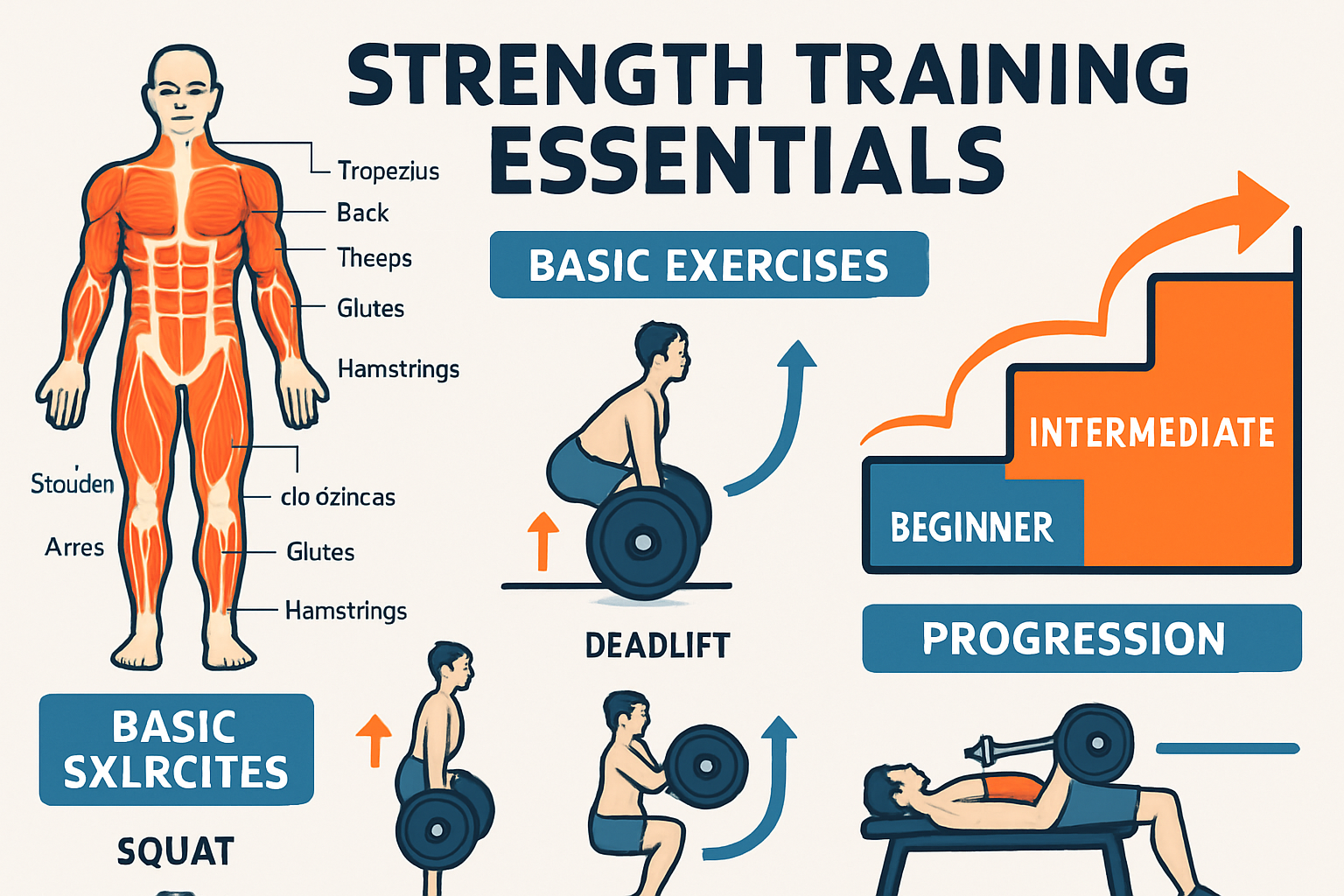
The Big Six Movement Patterns
Every effective strength training program is built around six fundamental movement patterns. Mastering these will give you a solid foundation for any exercise routine:
- Squat – Hip and knee dominant lower body movement
- Hinge – Hip dominant movement (deadlifts, hip thrusts)
- Push – Horizontal and vertical pushing movements
- Pull – Horizontal and vertical pulling movements
- Lunge – Single-leg movements for unilateral strength
- Carry – Core stability and functional strength
Beginner-Friendly Exercises by Muscle Group
Upper Body Exercises
Chest:
- Push-ups (start on knees if needed)
- Chest press (dumbbells or machine)
- Incline chest press
Back:
- Bent-over rows (dumbbells or barbell)
- Lat pulldowns
- Assisted pull-ups
Shoulders:
- Overhead press (dumbbells or barbell)
- Lateral raises
- Face pulls
Arms:
- Bicep curls
- Tricep dips (assisted if needed)
- Hammer curls
Lower Body Exercises
Quadriceps:
- Bodyweight squats
- Goblet squats
- Leg press
Hamstrings and Glutes:
- Romanian deadlifts
- Glute bridges
- Walking lunges
Calves:
- Calf raises
- Single-leg calf raises
Form Over Everything: Common Mistakes to Avoid
I cannot stress this enough: proper form is infinitely more important than the amount of weight you're lifting. Here are the most common mistakes I see beginners make:
Universal Form Principles:
- Keep your core engaged throughout every exercise
- Move through a full range of motion
- Control both the lifting and lowering phases
- Breathe properly (exhale on exertion, inhale on the return)
- Start with lighter weights to master the movement
Red Flags to Watch For:
- Rounding your back during deadlifts or rows
- Letting knees cave inward during squats
- Using momentum instead of muscle control
- Holding your breath during exercises
- Ego lifting (using weights too heavy for proper form)
If you're looking to enhance your strength training performance, you might want to explore pre-workout supplements for women to boost your energy and focus.
<!DOCTYPE html>
<html lang="en">
<head>
<meta charset="UTF-8">
<meta name="viewport" content="width=device-width, initial-scale=1.0">
<title>Beginner Strength Training Workout Planner</title>
<style>
.cg-element-container {
max-width: 800px;
margin: 20px auto;
padding: 20px;
background: linear-gradient(135deg, #667eea 0%, #764ba2 100%);
border-radius: 15px;
box-shadow: 0 10px 30px rgba(0,0,0,0.2);
color: white;
font-family: 'Arial', sans-serif;
}
.cg-element-header {
text-align: center;
margin-bottom: 30px;
}
.cg-element-title {
font-size: 28px;
font-weight: bold;
margin-bottom: 10px;
}
.cg-element-subtitle {
font-size: 16px;
opacity: 0.9;
}
.cg-element-controls {
display: grid;
grid-template-columns: repeat(auto-fit, minmax(200px, 1fr));
gap: 15px;
margin-bottom: 25px;
}
.cg-element-control-group {
background: rgba(255,255,255,0.1);
padding: 15px;
border-radius: 10px;
backdrop-filter: blur(10px);
}
.cg-element-label {
display: block;
margin-bottom: 8px;
font-weight: bold;
font-size: 14px;
}
.cg-element-select, .cg-element-input {
width: 100%;
padding: 10px;
border: none;
border-radius: 8px;
background: rgba(255,255,255,0.9);
color: #333;
font-size: 14px;
}
.cg-element-workout-plan {
background: rgba(255,255,255,0.95);
color: #333;
padding: 25px;
border-radius: 12px;
margin-top: 20px;
}
.cg-element-day {
margin-bottom: 20px;
padding: 15px;
background: #f8f9fa;
border-radius: 8px;
border-left: 4px solid #667eea;
}
.cg-element-day-title {
font-size: 18px;
font-weight: bold;
color: #667eea;
margin-bottom: 10px;
}
.cg-element-exercise {
display: flex;
justify-content: space-between;
align-items: center;
padding: 8px 0;
border-bottom: 1px solid #e9ecef;
}
.cg-element-exercise:last-child {
border-bottom: none;
}
.cg-element-exercise-name {
font-weight: 500;
}
.cg-element-exercise-details {
color: #666;
font-size: 14px;
}
.cg-element-rest-day {
text-align: center;
color: #28a745;
font-style: italic;
}
.cg-element-tips {
background: #e8f4f8;
padding: 15px;
border-radius: 8px;
margin-top: 20px;
border-left: 4px solid #17a2b8;
}
.cg-element-tips-title {
font-weight: bold;
color: #17a2b8;
margin-bottom: 10px;
}
@media (max-width: 600px) {
.cg-element-container {
margin: 10px;
padding: 15px;
}
.cg-element-controls {
grid-template-columns: 1fr;
}
.cg-element-exercise {
flex-direction: column;
align-items: flex-start;
}
}
</style>
</head>
<body>
<div class="cg-element-container">
<div class="cg-element-header">
<div class="cg-element-title">🏋️ Beginner Strength Training Planner</div>
<div class="cg-element-subtitle">Create your personalized weekly workout routine</div>
</div>
<div class="cg-element-controls">
<div class="cg-element-control-group">
<label class="cg-element-label">Fitness Level</label>
<select class="cg-element-select" id="fitnessLevel">
<option value="absolute-beginner">Absolute Beginner</option>
<option value="some-experience">Some Experience</option>
<option value="returning">Returning to Fitness</option>
</select>
</div>
<div class="cg-element-control-group">
<label class="cg-element-label">Days Per Week</label>
<select class="cg-element-select" id="daysPerWeek">
<option value="2">2 Days</option>
<option value="3" selected>3 Days</option>
<option value="4">4 Days</option>
</select>
</div>
<div class="cg-element-control-group">
<label class="cg-element-label">Equipment Available</label>
<select class="cg-element-select" id="equipment">
<option value="bodyweight">Bodyweight Only</option>
<option value="dumbbells">Dumbbells</option>
<option value="gym" selected>Full Gym Access</option>
</select>
</div>
<div class="cg-element-control-group">
<label class="cg-element-label">Primary Goal</label>
<select class="cg-element-select" id="goal">
<option value="strength">Build Strength</option>
<option value="muscle">Build Muscle</option>
<option value="tone" selected>Tone & Strengthen</option>
<option value="weight-loss">Weight Loss</option>
</select>
</div>
</div>
<div class="cg-element-workout-plan" id="workoutPlan">
<!-- Workout plan will be generated here -->
</div>
</div>
<script>
const workoutPlans = {
'absolute-beginner': {
2: {
'bodyweight': {
'Day 1': [
{ name: 'Bodyweight Squats', details: '2 sets × 8-12 reps' },
{ name: 'Wall Push-ups', details: '2 sets × 5-10 reps' },
{ name: 'Glute Bridges', details: '2 sets × 10-15 reps' },
{ name: 'Plank Hold', details: '2 sets × 15-30 seconds' },
{ name: 'Standing Calf Raises', details: '2 sets × 10-15 reps' }
],
'Day 2': [
{ name: 'Modified Lunges', details: '2 sets × 6-10 each leg' },
{ name: 'Knee Push-ups', details: '2 sets × 5-10 reps' },
{ name: 'Superman', details: '2 sets × 8-12 reps' },
{ name: 'Side Plank (Modified)', details: '2 sets × 10-20 seconds each side' },
{ name: 'Chair Dips', details: '2 sets × 5-10 reps' }
]
},
'dumbbells': {
'Day 1': [
{ name: 'Goblet Squats', details: '2 sets × 8-12 reps' },
{ name: 'Chest Press (lying)', details: '2 sets × 8-12 reps' },
{ name: 'Bent-over Row', details: '2 sets × 8-12 reps' },
{ name: 'Overhead Press', details: '2 sets × 6-10 reps' },
{ name: 'Romanian Deadlift', details: '2 sets × 8-12 reps' }
],
'Day 2': [
{ name: 'Reverse Lunges', details: '2 sets × 6-10 each leg' },
{ name: 'Bicep Curls', details: '2 sets × 10-15 reps' },
{ name: 'Tricep Extensions', details: '2 sets × 8-12 reps' },
{ name: 'Lateral Raises', details: '2 sets × 10-15 reps' },
{ name: 'Farmer's Walk', details: '2 sets × 20-30 seconds' }
]
},
'gym': {
'Day 1': [
{ name: 'Leg Press', details: '2 sets × 10-15 reps' },
{ name: 'Chest Press Machine', details: '2 sets × 8-12 reps' },
{ name: 'Seated Cable Row', details: '2 sets × 8-12 reps' },
{ name: 'Lat Pulldown', details: '2 sets × 8-12 reps' },
{ name: 'Leg Curl Machine', details: '2 sets × 10-15 reps' }
],
'Day 2': [
{ name: 'Goblet Squats', details: '2 sets × 8-12 reps' },
{ name: 'Shoulder Press Machine', details: '2 sets × 8-12 reps' },
{ name: 'Assisted Pull-ups', details: '2 sets × 5-10 reps' },
{ name: 'Leg Extension', details: '2 sets × 10-15 reps' },
{ name: 'Plank Hold', details: '2 sets × 20-45 seconds' }
]
}
},
3: {
'bodyweight': {
'Day 1': [
{ name: 'Bodyweight Squats', details: '3 sets × 8-12 reps' },
{ name: 'Push-ups (modified if needed)', details: '3 sets × 5-10 reps' },
{ name: 'Glute Bridges', details: '3 sets × 10-15 reps' },
{ name: 'Plank Hold', details: '3 sets × 15-30 seconds' }
],
'Day 2': [
{ name: 'Lunges', details: '3 sets × 6-10 each leg' },
{ name: 'Pike Push-ups', details: '3 sets × 5-8 reps' },
{ name: 'Superman', details: '3 sets × 8-12 reps' },
{ name: 'Side Plank', details: '3 sets × 10-20 seconds each side' }
],
'Day 3': [
{ name: 'Single-leg Glute Bridges', details: '3 sets × 8-12 each leg' },
{ name: 'Tricep Dips', details: '3 sets × 5-10 reps' },
{ name: 'Mountain Climbers', details: '3 sets × 10-20 reps' },
{ name: 'Dead Bug', details: '3 sets × 8-12 each side' }
]
},
'dumbbells': {
'Day 1': [
{ name: 'Goblet Squats', details: '3 sets × 8-12 reps' },
{ name: 'Chest Press', details: '3 sets × 8-12 reps' },
{ name: 'Bent-over Row', details: '3 sets × 8-12 reps' },
{ name: 'Romanian Deadlift', details: '3 sets × 8-12 reps' }
],
'Day 2': [
{ name: 'Overhead Press', details: '3 sets × 6-10 reps' },
{ name: 'Reverse Lunges', details: '3 sets × 8-12 each leg' },
{ name: 'Bicep Curls', details: '3 sets × 10-15 reps' },
{ name: 'Tricep Extensions', details: '3 sets × 8-12 reps' }
],
'Day 3': [
{ name: 'Sumo Squats', details: '3 sets × 10-15 reps' },
{ name: 'Lateral Raises', details: '3 sets × 10-15 reps' },
{ name: 'Hammer Curls', details: '3 sets × 10-15 reps' },
{ name: 'Russian Twists', details: '3 sets × 15-20 reps' }
]
},
'gym': {
'Day 1': [
{ name: 'Leg Press', details: '3 sets × 10-15 reps' },
{ name: 'Chest Press Machine', details: '3 sets × 8-12 reps' },
{ name: 'Seated Cable Row', details: '3 sets × 8-12 reps' },
{ name: 'Leg Curl Machine', details: '3 sets × 10-15 reps' }
],
'Day 2': [
{ name: 'Lat Pulldown', details: '3 sets × 8-12 reps' },
{ name: 'Shoulder Press Machine', details: '3 sets × 8-12 reps' },
{ name: 'Leg Extension', details: '3 sets × 10-15 reps' },
{ name: 'Cable Bicep Curls', details: '3 sets × 10-15 reps' }
],
'Day 3': [
{ name: 'Goblet Squats', details: '3 sets × 8-12 reps' },
{ name: 'Assisted Pull-ups', details: '3 sets × 5-10 reps' },
{ name: 'Cable Tricep Pushdowns', details: '3 sets × 10-15 reps' },
{ name: 'Plank Hold', details: '3 sets × 20-45 seconds' }
]
}
}
}
};
function generateWorkout() {
const fitnessLevel = document.getElementById('fitnessLevel').value;
const daysPerWeek = document.getElementById('daysPerWeek').value;
const equipment = document.getElementById('equipment').value;
const goal = document.getElementById('goal').value;
const workoutContainer = document.getElementById('workoutPlan');
// Get the appropriate workout plan
let plan = workoutPlans[fitnessLevel] && workoutPlans[fitnessLevel][daysPerWeek] && workoutPlans[fitnessLevel][daysPerWeek][equipment];
if (!plan) {
plan = workoutPlans['absolute-beginner']['3']['bodyweight'];
}
let html = '<div class="cg-element-day-title" style="text-align: center; margin-bottom: 20px; color: #667eea;">Your Personalized Weekly Plan</div>';
// Generate workout days
const dayNames = ['Monday', 'Tuesday', 'Wednesday', 'Thursday', 'Friday', 'Saturday', 'Sunday'];
let dayIndex = 0;
let workoutDayCount = 0;
for (let i = 0; i < 7; i++) {
const dayName = dayNames[i];
if (workoutDayCount < parseInt(daysPerWeek) && (i % 2 === 0 || parseInt(daysPerWeek) > 3)) {
workoutDayCount++;
const planKey = `Day ${workoutDayCount}`;
const exercises = plan[planKey] || plan['Day 1'];
html += `
<div class="cg-element-day">
<div class="cg-element-day-title">${dayName} - Workout ${workoutDayCount}</div>
${exercises.map(exercise => `
<div class="cg-element-exercise">
<span class="cg-element-exercise-name">${exercise.name}</span>
<span class="cg-element-exercise-details">${exercise.details}</span>
</div>
`).join('')}
</div>
`;
} else {
html += `
<div class="cg-element-day">
<div class="cg-element-day-title">${dayName}</div>
<div class="cg-element-rest-day">Rest Day or Light Activity (walking, stretching)</div>
</div>
`;
}
}
// Add tips based on goal
const tips = {
'strength': 'Focus on progressive overload by gradually increasing weight each week. Rest 48-72 hours between sessions.',
'muscle': 'Ensure adequate protein intake (0.8-1g per lb bodyweight) and get 7-9 hours of sleep for muscle recovery.',
'tone': 'Combine strength training with light cardio and maintain a balanced diet for best results.',
'weight-loss': 'Pair your strength training with cardio and create a moderate caloric deficit through diet.'
};
html += `
<div class="cg-element-tips">
<div class="cg-element-tips-title">💡 Pro Tip for Your Goal:</div>
<div>${tips[goal]}</div>
</div>
`;
workoutContainer.innerHTML = html;
}
// Event listeners
document.getElementById('fitnessLevel').addEventListener('change', generateWorkout);
document.getElementById('daysPerWeek').addEventListener('change', generateWorkout);
document.getElementById('equipment').addEventListener('change', generateWorkout);
document.getElementById('goal').addEventListener('change', generateWorkout);
// Generate initial workout
generateWorkout();
</script>
</body>
</html>
Creating Your First Strength Training Routine
The Beginner's Blueprint: 2-3 Day Split
When starting out, less is more. Your muscles need time to adapt and recover, so I recommend beginning with 2-3 strength training sessions per week with at least one day of rest between sessions.
Sample 3-Day Beginner Routine:
Day 1: Upper Body Focus
- Push-ups or chest press: 3 sets × 8-12 reps
- Bent-over rows: 3 sets × 8-12 reps
- Overhead press: 3 sets × 6-10 reps
- Bicep curls: 2 sets × 10-15 reps
- Tricep dips: 2 sets × 6-12 reps
Day 2: Lower Body Focus
- Squats: 3 sets × 8-12 reps
- Romanian deadlifts: 3 sets × 8-12 reps
- Lunges: 2 sets × 8-12 each leg
- Glute bridges: 3 sets × 12-15 reps
- Calf raises: 2 sets × 15-20 reps
Day 3: Full Body
- Goblet squats: 2 sets × 10-15 reps
- Push-ups: 2 sets × 5-12 reps
- Plank: 2 sets × 20-45 seconds
- Glute bridges: 2 sets × 12-15 reps
- Face pulls or reverse flies: 2 sets × 12-15 reps
Progressive Overload: The Key to Continuous Improvement
Progressive overload is the gradual increase of stress placed on your muscles during exercise. Without it, your body adapts to your current routine and stops making progress. Here's how to implement it:
Methods of Progressive Overload:
- Increase weight – Add 2.5-5 pounds when you can complete all sets with perfect form
- Increase reps – Add 1-2 reps per set when possible
- Increase sets – Add an extra set to challenging exercises
- Improve form – Focus on slower, more controlled movements
- Decrease rest time – Gradually reduce rest periods between sets
Progression Timeline:
- Weeks 1-2: Focus on learning proper form with light weights
- Weeks 3-4: Increase weight by 5-10% if form remains perfect
- Weeks 5-8: Continue progressive overload while monitoring recovery
- Week 9: Deload week with 10-20% less weight for recovery
For those looking to combine strength training with weight loss goals, check out these sustainable weight loss strategies for women that complement your training routine.
Rest and Recovery: The Forgotten Component
Recovery isn't just about taking days off – it's an active process that determines your success. Your muscles grow during rest, not during workouts.
Recovery Essentials:
- Sleep: Aim for 7-9 hours per night for optimal muscle recovery
- Nutrition: Consume adequate protein (0.8-1g per pound of body weight)
- Hydration: Drink at least 8-10 glasses of water daily
- Active recovery: Light walking, stretching, or yoga on rest days
- Stress management: High stress levels can impair recovery
Signs You Need More Recovery:
- Persistent muscle soreness lasting more than 72 hours
- Decreased performance in subsequent workouts
- Feeling unusually fatigued or irritable
- Trouble sleeping or staying asleep
- Loss of motivation to exercise
Nutrition and Lifestyle Factors for Success
Fueling Your Strength Training Journey
What you eat plays a crucial role in your strength training success. You can't out-train a poor diet, and this is especially true when building muscle and strength.
Pre-Workout Nutrition (1-2 hours before):
- Complex carbohydrates for energy (oatmeal, banana, whole grain toast)
- Small amount of protein (Greek yogurt, protein shake)
- Avoid high-fat or high-fiber foods that may cause digestive issues
Post-Workout Nutrition (within 30-60 minutes):
- Protein for muscle repair (20-30g from whey protein, chicken, eggs)
- Carbohydrates to replenish glycogen stores
- Hydration to replace fluids lost through sweat
For women over 50, nutritional needs may differ slightly. Consider exploring weight loss diet options for women over 50 that support strength training goals.
Hydration and Supplementation
Hydration Guidelines:
- Drink 16-20 oz of water 2-3 hours before exercising
- Consume 8 oz of water 20-30 minutes before starting
- Drink 7-10 oz every 10-20 minutes during exercise
- Replace 150% of fluid lost through sweat post-workout
Beginner-Friendly Supplements:
- Whey protein powder – Convenient way to meet protein needs
- Creatine monohydrate – Improves strength and power output (3-5g daily)
- Multivitamin – Covers nutritional gaps in your diet
- Omega-3 fatty acids – Reduces inflammation and supports recovery
"The best workout is the one you'll actually do consistently. Start small, focus on form, and gradually build intensity over time." – Fitness Expert
Creating Sustainable Habits
The difference between those who succeed long-term and those who quit after a few weeks comes down to habit formation. Here's how to make strength training stick:
Habit Stacking Strategies:
- Link your workout to an existing habit (after morning coffee, before dinner)
- Prepare your workout clothes the night before
- Schedule workouts like important appointments
- Find an accountability partner or join a fitness community
- Track your progress with a simple log or app
Overcoming Common Obstacles:
- "I don't have time" – Start with 20-minute sessions, 2x per week
- "I'm too tired" – Exercise actually increases energy levels over time
- "It's too intimidating" – Start at home or during off-peak gym hours
- "I'm not seeing results" – Progress takes 4-6 weeks to become noticeable
If you're looking for additional ways to stay active on rest days, consider incorporating walking as your secret weapon for better health into your routine.
Troubleshooting Common Beginner Challenges
Dealing with Muscle Soreness
DOMS (Delayed Onset Muscle Soreness) is completely normal for beginners and typically peaks 24-72 hours after exercise. Here's how to manage it:
Immediate Relief Strategies:
- Light movement and stretching
- Warm baths with Epsom salts
- Gentle massage or foam rolling
- Anti-inflammatory foods (cherries, leafy greens, fatty fish)
- Adequate sleep and hydration
When to Be Concerned:
- Sharp, shooting pains during exercise
- Pain that worsens rather than improves after 72 hours
- Swelling or significant bruising
- Joint pain rather than muscle soreness
Plateau Busting Techniques
Every lifter eventually hits a plateau where progress stalls. Here's how to break through:
Plateau-Breaking Strategies:
- Change your rep ranges – If you've been doing 8-12 reps, try 12-15 or 5-8
- Alter your exercise selection – Substitute similar movements
- Adjust training frequency – Add or reduce training days
- Focus on weak points – Identify and address muscle imbalances
- Take a deload week – Reduce intensity by 20-30% for recovery
Building Confidence in the Gym
Gym intimidation is real, but remember that everyone started as a beginner. Here are strategies to build confidence:
Confidence-Building Tips:
- Visit during off-peak hours initially (mid-morning or early afternoon)
- Bring a knowledgeable friend for your first few sessions
- Consider hiring a personal trainer for 2-3 sessions to learn the basics
- Focus on your own workout rather than comparing yourself to others
- Remember that most people are focused on their own workouts, not judging you
Gym Etiquette Basics:
- Wipe down equipment after use
- Return weights to their proper location
- Don't monopolize equipment during busy times
- Ask politely if you can work in on equipment
- Keep phone conversations brief and quiet
For those who prefer working out at home, you might find value in learning how to get fit at home with minimal equipment.
Tracking Progress and Setting Realistic Goals
Measuring Success Beyond the Scale
While weight loss might be a goal, strength training success should be measured in multiple ways:
Progress Tracking Methods:
- Strength gains – Can you lift heavier weights or do more reps?
- Body measurements – Track waist, hips, arms, and thighs
- Progress photos – Take monthly photos in consistent lighting/poses
- Energy levels – Do you feel stronger and more energetic daily?
- Sleep quality – Are you sleeping better and feeling more rested?
- Mood improvements – Strength training is a powerful mood booster
Setting SMART Fitness Goals
SMART goals are Specific, Measurable, Achievable, Relevant, and Time-bound. Here are examples:
Poor Goal: "I want to get stronger"
SMART Goal: "I want to increase my squat weight from 65 pounds to 85 pounds within 8 weeks"
Goal-Setting Framework:
- Short-term (4-6 weeks): Master proper form, establish routine consistency
- Medium-term (3-6 months): Achieve specific strength or physique milestones
- Long-term (6-12 months): Complete a fitness challenge or reach major strength goals
Sample Beginner Goals:
- Complete 12 consecutive workouts without missing a session
- Perform 10 full push-ups from toes (if starting from knees)
- Squat your body weight for 5 reps
- Hold a plank for 60 seconds
- Complete a beginner strength training program
The Power of Community and Accountability
Finding Your Fitness Tribe:
- Join online fitness communities and forums
- Participate in group fitness classes
- Find a workout buddy with similar goals
- Consider working with a personal trainer initially
- Share your journey on social media for accountability
Having support makes a tremendous difference in long-term success. Whether it's celebrating small wins or pushing through challenging days, community support can be the difference between giving up and pushing forward.
Advanced Tips for Continued Growth
When to Progress to Intermediate Programming
After 3-6 months of consistent training, you might be ready for more advanced programming. Signs you're ready to progress:
- You can perform all exercises with perfect form
- You've mastered the basic movement patterns
- You're consistently progressive overloading
- You're ready for more training volume
- You want to focus on specific goals (powerlifting, bodybuilding, etc.)
Periodization for Beginners
Periodization is the systematic planning of training to achieve peak performance. Even beginners can benefit from basic periodization:
Simple Linear Periodization:
- Weeks 1-4: High reps (12-15), lighter weights, focus on form
- Weeks 5-8: Moderate reps (8-12), moderate weights, build strength
- Weeks 9-12: Lower reps (6-8), heavier weights, peak strength
- Week 13: Deload week with reduced volume
Incorporating Cardio with Strength Training
Many beginners wonder how to balance cardio and strength training. Here's my recommendation:
Optimal Cardio Integration:
- Strength training days: 5-10 minutes light cardio warm-up
- Rest days: 20-30 minutes moderate cardio (walking, cycling, swimming)
- Post-workout: 5-10 minutes cool-down cardio
- Separate days: Longer cardio sessions on non-strength training days
For more specific cardio guidance, explore these cardio workouts at home that complement your strength training routine.
Conclusion
Starting your strength training journey as a beginner doesn't have to be overwhelming or intimidating. By focusing on the fundamentals – proper form, progressive overload, adequate recovery, and consistency – you'll build a solid foundation for lifelong fitness success.
Remember, every expert was once a beginner. The key is to start where you are, use what you have, and do what you can. Your strength training journey is unique to you, so avoid comparing your progress to others and celebrate every small victory along the way.
Your Next Steps:
- Start this week – Choose 2-3 exercises from this guide and perform them twice this week
- Focus on form – Master the movement patterns before adding weight
- Track your progress – Keep a simple log of exercises, sets, reps, and weights used
- Be patient – Allow 4-6 weeks to see noticeable changes in strength and body composition
- Stay consistent – Aim for 2-3 strength training sessions per week for the next month
The journey of a thousand miles begins with a single step, and your first strength training session is that crucial first step. You have all the knowledge you need to begin – now it's time to take action and transform your health, strength, and confidence through the power of resistance training.
Your future stronger self is waiting. Let's get started! 💪
References
[1] Wolff, I., et al. (1999). The effect of exercise training programs on bone mass: a meta-analysis. Journal of Bone and Mineral Research, 14(10), 1672-1679.
[2] Pratley, R., et al. (1994). Strength training increases resting metabolic rate and norepinephrine levels in healthy 50- to 65-yr-old men. Journal of Applied Physiology, 76(1), 133-137.
[3] Holten, M. K., et al. (2004). Strength training increases insulin-mediated glucose uptake, GLUT4 content, and insulin signaling in skeletal muscle. Journal of Applied Physiology, 97(4), 1293-1298.
[4] Gordon, B. R., et al. (2018). Association of efficacy of resistance exercise training with depressive symptoms: meta-analysis and meta-regression analysis. JAMA Psychiatry, 75(6), 566-576.
SEO Meta Information
Meta Title: Strength Training for Beginners: Complete Guide to Building Muscle 2025
Meta Description: Master strength training basics with our beginner's guide. Learn proper form, essential exercises, and proven routines to build muscle safely and effectively.
Frequently Asked Questions
Strength training involves using resistance to build muscle and improve overall strength. It’s important because it boosts metabolism, enhances bone density, and improves functional fitness.
Beginners should aim for 2-3 strength training sessions per week, allowing rest days in between for recovery. Consistency is key, and gradually increasing intensity can lead to great results.
No, you can start strength training at home using bodyweight exercises, resistance bands, or light weights. Many effective workouts can be done without any specialized equipment.
Some great beginner exercises include squats, push-ups, lunges, and dumbbell shoulder presses. These movements target multiple muscle groups and help build a solid foundation.
Setting realistic goals and tracking your progress can help maintain motivation. Additionally, finding a workout buddy or joining a community can provide support and encouragement throughout your fitness journey.
 DK Gets Fit Team