
Beginner Fitness Guide for All Levels: Essential Fitness Basics and How to Start
Starting a fitness journey can feel overwhelming, especially when faced with endless workout videos, conflicting advice, and intimidating gym environments. Here’s the truth: fitness doesn’t have to be complicated or scary. Whether someone is stepping into a gym for the first time or returning after years away, this 1 Beginner Fitness Guide for All Levels: Essential fitness basics and how to start provides everything needed to build a strong foundation for lifelong health and wellness.
The beauty of beginning a fitness routine lies in its simplicity. With just 2-3 training sessions per week, lasting only 25-30 minutes each, anyone can start building strength, improving health, and gaining confidence[1]. This comprehensive guide breaks down the essential fitness basics into manageable, actionable steps that work for every fitness level.
Key Takeaways
• Start with 2-3 workout sessions per week for 25-30 minutes each to build a sustainable routine without overwhelming the body
• Master five foundational movement patterns (squat, hinge, push, pull, lunge) before progressing to complex exercises
• Focus on proper form over heavy weights – technique and consistency create lasting results and prevent injuries
• Include rest days and light activities like walking between training sessions for optimal recovery and progress
• Progressive overload should be gradual – small, consistent increases in weight or reps lead to sustainable strength gains
Understanding Fitness Fundamentals: Your Foundation for Success
What Makes a Beginner Fitness Program Effective?
The most effective 1 Beginner Fitness Guide for All Levels: Essential fitness basics and how to start focuses on building habits rather than chasing quick fixes. Research shows that beginners who train 2-3 days per week see significant improvements in strength, endurance, and overall health[1]. This frequency allows the body to adapt while providing adequate recovery time.
Key principles include:
- ✅ Consistency over intensity – regular moderate exercise beats sporadic intense sessions
- ✅ Progressive overload – gradually increasing challenge as strength improves
- ✅ Proper form – quality movement patterns prevent injury and maximize results
- ✅ Adequate recovery – muscles grow and strengthen during rest periods
The Science Behind Beginner Training
When starting a fitness routine, the body undergoes remarkable adaptations. During the first 12 weeks, beginners typically experience:
| Week Range | Primary Adaptations | Expected Changes |
|---|---|---|
| 1-4 | Nervous system improvements | Better coordination, less shaking |
| 5-8 | Strength gains | Increased weight capacity, better form |
| 9-12 | Muscle development | Visible changes, improved posture |
These adaptations happen because the body is incredibly efficient at responding to new challenges. The key is providing consistent, appropriate stimulus through well-designed workouts.
Essential Movement Patterns: The Building Blocks of Fitness
The Five Foundational Movements
Every effective 1 Beginner Fitness Guide for All Levels: Essential fitness basics and how to start centers around five fundamental movement patterns that humans perform daily[1]. Mastering these movements creates a strong foundation for all future fitness activities.
1. Squat Pattern 🏋️♀️
- What it targets: Legs, glutes, core
- Daily application: Sitting down and standing up
- Beginner exercise: Bodyweight squats, box squats
2. Hinge Pattern
- What it targets: Hamstrings, glutes, lower back
- Daily application: Picking up objects from the floor
- Beginner exercise: Glute bridges, Romanian deadlifts with light weights
3. Push Pattern
- What it targets: Chest, shoulders, triceps
- Daily application: Pushing doors, lifting objects overhead
- Beginner exercise: Wall push-ups, incline push-ups
4. Pull Pattern
- What it targets: Back muscles, biceps, rear shoulders
- Daily application: Opening doors, pulling objects toward the body
- Beginner exercise: Seated rows, assisted pull-ups
5. Lunge Pattern
- What it targets: Legs, glutes, balance, coordination
- Daily application: Climbing stairs, stepping over obstacles
- Beginner exercise: Stationary lunges, step-ups
Form Focus Points for Each Movement
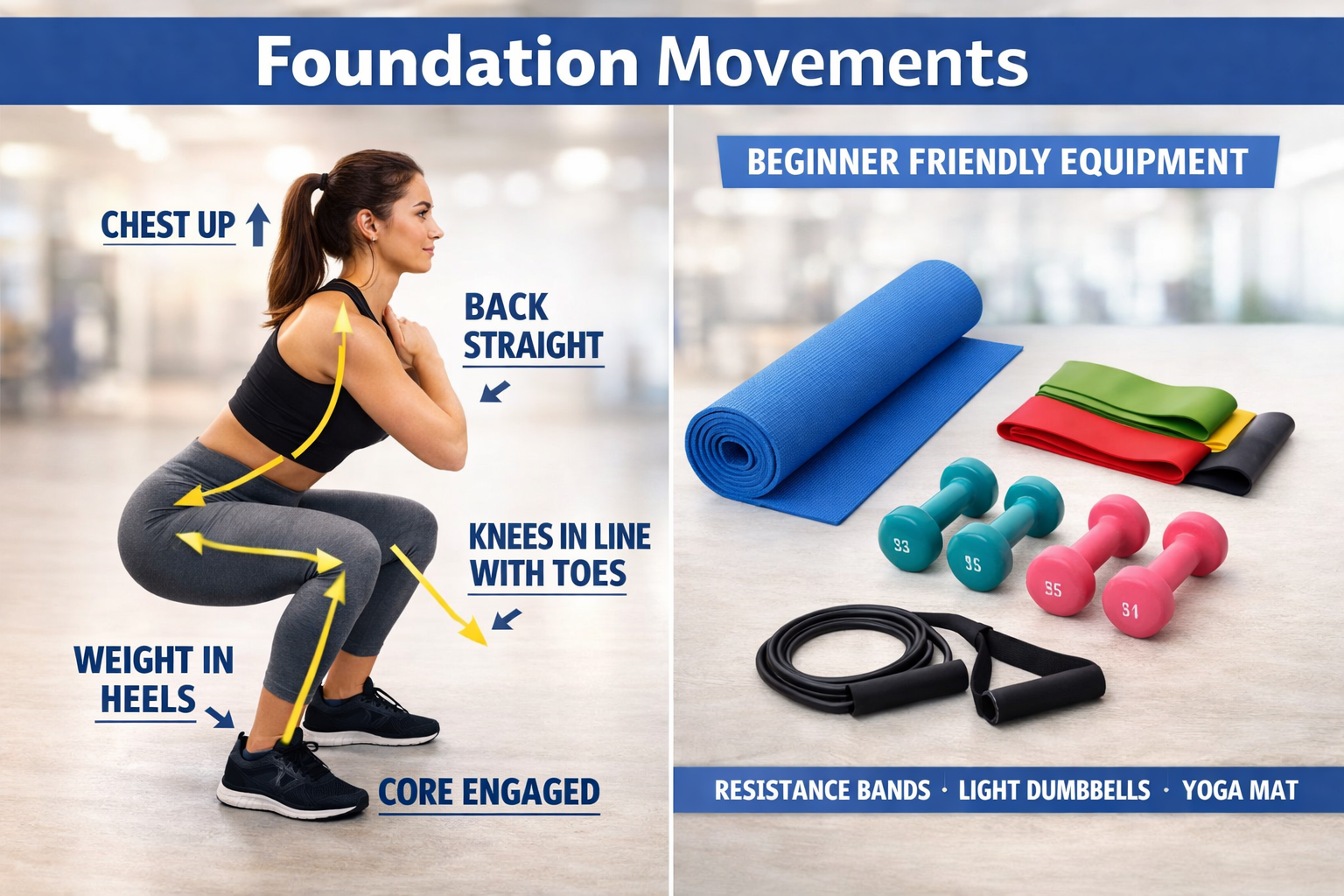
Proper form is non-negotiable in any beginner fitness program. Focus on these key points:
- Neutral spine: Maintain natural curves in the back
- Ribs over hips: Keep torso aligned and engaged
- Knees tracking forward: Prevent inward knee collapse
- Controlled tempo: Slow, deliberate movements build strength and control[1]
For those just starting their fitness journey, spending extra time on form pays dividends in both safety and results.
Creating Your Weekly Workout Structure
The Optimal Beginner Schedule
A well-designed 1 Beginner Fitness Guide for All Levels: Essential fitness basics and how to start includes 3-4 training days with built-in rest days for recovery and adaptation[2]. This structure allows consistent progress while preventing burnout and overuse injuries.
Sample Weekly Structure:
Monday: Full-body strength training (25-30 minutes)
Tuesday: Light activity – walking workouts or stretching
Wednesday: Full-body strength training (25-30 minutes)
Thursday: Active recovery – gentle yoga or mobility work
Friday: Full-body strength training (25-30 minutes)
Saturday: Fun activity – hiking, dancing, or recreational sports
Sunday: Complete rest or gentle stretching
The Power of Active Recovery
Rest days don’t mean complete inactivity. Light activity days should include walking, stretching, or mobility work between strength sessions for active recovery[2]. This approach:
- Promotes blood flow to healing muscles
- Reduces stiffness and soreness
- Maintains movement habits
- Supports mental well-being
Consider incorporating walking for fitness on recovery days. Walking provides gentle cardiovascular benefits while allowing muscles used for strength training to recover.
Designing Your First Workout Program
The 25-30 Minute Full-Body Session
Each training session in this 1 Beginner Fitness Guide for All Levels: Essential fitness basics and how to start follows a proven structure that maximizes results in minimal time[1]:
Warm-up (5 minutes)
- Light cardio (marching in place, arm circles)
- Dynamic stretching (leg swings, arm swings)
- Movement preparation (bodyweight squats, shoulder rolls)
Main Workout (15-20 minutes)
- Compound lifts first: Focus on major movement patterns while fresh[4]
- Main lifts: 3 sets of 8-10 repetitions
- Accessory exercises: 2-3 sets of 10-12 repetitions[1]
Cool-down (5 minutes)
- Static stretching for major muscle groups
- Deep breathing exercises
- Light walking to gradually lower heart rate
Sample Beginner Workout
Week 1-4 Full-Body Routine:
| Exercise | Sets | Reps | Rest |
|---|---|---|---|
| Bodyweight Squat | 3 | 8-10 | 60 seconds |
| Wall Push-up | 3 | 8-10 | 60 seconds |
| Glute Bridge | 3 | 10-12 | 45 seconds |
| Seated Row (band) | 3 | 10-12 | 45 seconds |
| Modified Plank | 2 | 15-30 seconds | 45 seconds |
This routine covers all major movement patterns while using minimal equipment. As strength improves, progress to more challenging variations.
Progressive Overload: The Key to Continuous Improvement
Understanding Progressive Overload
Progressive overload forms the cornerstone of any effective fitness program. This principle involves gradually increasing the demands placed on muscles to stimulate continued adaptation and growth[1]. For beginners, this progression should be scaled safely and consistently rather than dramatically.
Signs It’s Time to Progress
Recognizing when to increase difficulty ensures continuous improvement without risking injury. Progress indicators include[1]:
- ✅ Completing all sets and reps with good form
- ✅ Feeling like 2-3 more reps would be possible
- ✅ Less muscle shaking during exercises
- ✅ Improved movement control and confidence
- ✅ Increased energy levels throughout the day
- ✅ Better posture and body awareness
Safe Progression Strategies
Week-by-Week Progression Plan:
Weeks 1-2: Focus entirely on form and movement quality
Weeks 3-4: Add 1-2 reps per set when possible
Weeks 5-6: Introduce light resistance (bands, light weights)
Weeks 7-8: Increase resistance slightly or add more challenging exercise variations
Weeks 9-12: Continue gradual increases while maintaining perfect form
The goal is for weights to feel challenging near the end of sets but manageable with good form. If exercises feel easy throughout, it’s time to increase the load[1].
Avoiding Common Beginner Mistakes
The “Too Much, Too Soon” Trap
Many beginners sabotage their success by attempting advanced workouts immediately. This 1 Beginner Fitness Guide for All Levels: Essential fitness basics and how to start emphasizes starting conservatively and building gradually.
Common mistakes to avoid:
❌ Training every day without rest
❌ Lifting weights that are too heavy
❌ Copying advanced workout routines
❌ Ignoring proper form for heavier weights
❌ Expecting immediate dramatic results
Building Sustainable Habits
Success comes from consistency, not perfection. Focus on these habit-building strategies:
- Start with just 2 days per week if 3 feels overwhelming
- Celebrate small victories and progress milestones
- Track workouts to see improvement over time
- Find activities that are genuinely enjoyable
- Connect with supportive fitness communities
For those looking to expand their routine, exploring cardio workouts at home can complement strength training beautifully.
Nutrition Basics for Beginners
Fueling Your Fitness Journey
While this 1 Beginner Fitness Guide for All Levels: Essential fitness basics and how to start focuses primarily on exercise, basic nutrition knowledge supports fitness goals effectively.
Simple nutrition guidelines:
- Eat adequate protein (aim for a palm-sized portion with each meal)
- Include vegetables with most meals for vitamins and minerals
- Stay hydrated throughout the day, especially around workouts
- Time carbohydrates around workouts for energy and recovery
- Don’t drastically cut calories while starting a new exercise routine
Pre and Post-Workout Nutrition
Before workouts (30-60 minutes prior):
- Light snack with carbohydrates for energy
- Examples: banana, small handful of berries, or a piece of toast
After workouts (within 2 hours):
- A combination of protein and carbohydrates for recovery
- Examples: Greek yogurt with fruit, protein smoothie, or balanced meal
For those interested in weight management, our guide on sustainable weight loss strategies for women provides evidence-based approaches that complement fitness routines.
Equipment and Setup for Success
Starting with Minimal Equipment
One barrier many beginners face is the belief that they need expensive equipment or gym memberships. This 1 Beginner Fitness Guide for All Levels: Essential fitness basics and how to start can be implemented with minimal investment.
Essential beginner equipment (under $50):
- Resistance bands (multiple resistance levels)
- Yoga or exercise mat
- Set of light dumbbells (5-15 pounds)
- Stability ball (optional but helpful)
Home vs. Gym Training
Home training advantages:
- Privacy and comfort
- No commute time
- Cost-effective
- Flexible scheduling
Gym training advantages:
- More equipment variety
- Professional atmosphere
- Social motivation
- Expert guidance available
Both options work excellently for beginners. Choose based on personal preferences, budget, and lifestyle factors. Our guide on how to get fit at home provides detailed strategies for effective home workouts.
Tracking Progress and Staying Motivated
Meaningful Progress Metrics
Beyond the scale – track these important indicators:
📊 Strength improvements (more weight or reps completed)
📊 Energy levels throughout the day
📊 Sleep quality and recovery
📊 Mood and stress management
📊 Movement quality and confidence
📊 Consistency with workout schedule
Creating Accountability Systems
Strategies for long-term success:
- Workout journal – record exercises, weights, and how you feel
- Progress photos – visual documentation of changes
- Fitness buddy – find someone with similar goals
- Professional guidance – consider working with a trainer initially
- Celebrate milestones – acknowledge achievements along the way
Adapting the Program for Different Fitness Levels
True Beginners (Never Exercised Regularly)
For complete beginners, this 1 Beginner Fitness Guide for All Levels: Essential fitness basics and how to start can be modified:
- Start with 2 days per week for the first month
- Focus on bodyweight exercises exclusively
- Extend the learning phase to 6-8 weeks
- Emphasize movement quality over quantity
- Consider working with a qualified trainer initially
Returning After Time Off
For those returning to fitness after months or years away:
- Begin conservatively regardless of previous fitness level
- Expect some initial soreness and fatigue
- Progress slightly faster than true beginners
- Listen to your body and adjust accordingly
- Be patient with the re-adaptation process
Special Considerations
For women over 50: Our best weight loss workout guide provides age-specific modifications and considerations.
For those with previous injuries: Always consult healthcare providers before beginning new exercise programs.
Long-Term Success Strategies
The 12-Week Milestone and Beyond
A typical 12-week progressive plan serves as an excellent foundation[2]. After completing the initial program:
Weeks 13-16: Introduce new exercise variations
Weeks 17-20: Add a fourth training day if desired
Weeks 21-24: Explore specific goals (strength, endurance, etc.)
Beyond 6 months: Consider specialized programs based on interests
Preventing Plateaus
Strategies to maintain progress:
- Regularly assess and adjust training variables
- Incorporate new activities and challenges
- Set both short-term and long-term goals
- Continue learning about fitness and health
- Stay connected with the fitness community
Building a Lifelong Practice
The ultimate goal of any 1 Beginner Fitness Guide for All Levels: Essential fitness basics and how to start is creating sustainable, lifelong habits. Focus on:
- Finding activities you genuinely enjoy
- Viewing fitness as self-care, not punishment
- Celebrating non-scale victories
- Adapting routines as life circumstances change
- Maintaining perspective on the bigger picture of health
Conclusion
Embarking on a fitness journey doesn’t require perfection, expensive equipment, or hours of daily commitment. This 1 Beginner Fitness Guide for All Levels: Essential fitness basics and how to start demonstrates that with just 2-3 weekly sessions of 25-30 minutes each, anyone can build strength, improve health, and gain confidence.
Your next steps are simple:
- Choose your start date and commit to just one week of the basic routine
- Focus on the five foundational movements with perfect form over heavy weights
- Schedule your workouts like important appointments you wouldn’t miss
- Track your progress using metrics beyond just the scale
- Be patient with the process – meaningful changes take time but are absolutely worth it
Remember, every fitness expert was once a beginner. The most important step is the first one. Whether the goal is improved health, increased strength, weight management, or simply feeling better in daily life, this guide provides the roadmap for success.
Start today, stay consistent, and trust the process. The future, stronger, healthier version of yourself is waiting just 12 weeks away.
References
[1] Beginner Strength Training Guide 2026 – https://obefitness.com/blog/beginner-strength-training-guide-2026
[2] 2026 Workout Plan – https://www.goldsgym.com/blog/2026-workout-plan/
[3] Watch – https://www.youtube.com/watch?v=2be0xWGOgJY&vl=en
[4] 2026 Fitness Roadmap – https://www.goldsgym.com/blog/2026-fitness-roadmap/
[5] How To Kickstart Your 2026 Fitness Journey – https://aeke.com/blogs/fitness/how-to-kickstart-your-2026-fitness-journey
Meta Title: Complete Beginner Fitness Guide 2026: Essential Basics to Start
Meta Description: Master fitness basics with our beginner guide. Learn essential movements, create effective routines, and start your fitness journey safely in 2026.